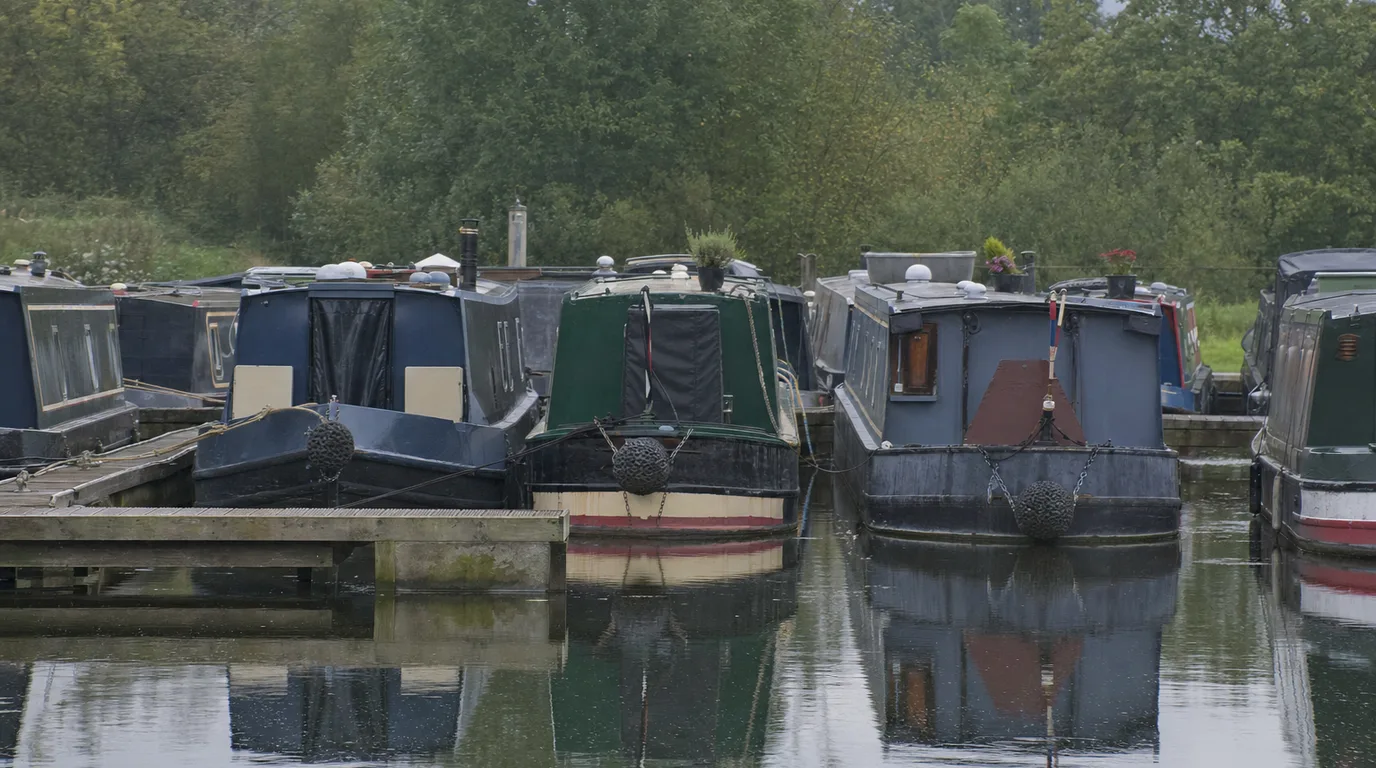
In short. A wide beam narrowboat is a canal boat wider than the 7 ft the Canal & River Trust gives as the limit for its narrow waterways. It can use only the waterways broad enough to take it, it pays a licence surcharge above 2.16 m of beam, and it has to book passage through Braunston and Blisworth tunnels if it uses them. This guide gives the Trust's own figures for each, read on 29 September 2026.
What counts as a wide beam narrowboat
The Trust marks some waterways "(narrow)" and says they "are not suitable for boats with a beam greater than 2.13m (7ft)". Its guide to wide beam boats page describes a wide beam boat as "anything wider than 7ft". Wikipedia, a secondary source, defines a widebeam as "a canal boat built in the style of a British narrowboat but with a beam of 2.16 metres (7 ft 1 in) or greater"; Wikipedia. The Trust's licence surcharge applies to beams over 2.16 m. We found no Trust definition of a "broad" beam.
Where a wide beam narrowboat can go
The Trust says that "width is probably the main limiting factor (especially at bridge holes and locks)". The chart shows the maximum beam it publishes for these waterways on its waterway dimensions page, with two narrow waterways at the bottom for comparison.
| Waterway | Length | Beam | Draught | Headroom |
|---|---|---|---|---|
| Stainforth & Keadby Canal | 18.8 m (61 ft 8 in) | 5.2 m (17 ft 1 in) | 2.22 m (7 ft 3 in) | 3.3 m (10 ft 10 in) |
| Kennet & Avon Canal: Hanham Lock to Bridge 194 (Bath) | 22.55 m (74 ft) | 4.88 m (16 ft) | 1.3 m (4 ft 3 in) | 2.67 m (8 ft 10 in) |
| Fossdyke Navigation | 21.3 m (70 ft) | 4.67 m (15 ft 4 in) | 1.52 m (4 ft 11 in) | 3.66 m (12 ft) |
| Lancaster Canal: main line | 21.95 m (72 ft) | 4.65 m (15 ft 3 in) | 0.99 m (3 ft 3 in) | 2.49 m (8 ft 2 in) |
| Hertford Union Canal | 21.95 m (72 ft) | 4.45 m (14 ft 7 in) | 1.3 m (4 ft 3 in) | 2.44 m (8 ft) |
| Regent's Canal | 21.95 m (72 ft) | 4.34 m (14 ft 3 in) | 1.17 m (3 ft 10 in) | 2.67 m (8 ft 9 in) |
| Leeds & Liverpool Canal | 19.51 m (64 ft) | 4.34 m (14 ft 3 in) | 1.22 m (4 ft) | 2.67 m (8 ft 9 in) |
| Kennet & Avon Canal: Bridge 194 to Blakes Lock (Reading) | 21.95 m (72 ft) | 4 m (13 ft 1 in) | 1.1 m (3 ft 7 in) | 2.4 m (7 ft 10 in) |
| Erewash Canal | 21.95 m (72 ft) | 3.2 m (10 ft 6 in) | 0.91 m (3 ft) | 2.03 m (6 ft 8 in) |
| Bridgwater & Taunton Canal | 15.24 m (50 ft) | 3.2 m (10 ft 6 in) | 0.9 m (2 ft 11 in) | 2.1 m (6 ft 10 in) |
| Leicester Line: Foxton to Kings Lock | 21.95 m (72 ft) | 3.05 m (10 ft) | 1 m (3 ft 3 in) | 2.23 m (7 ft) |
Notes the Trust prints beside two rows: on the Erewash Canal, "Beam is limited by low arched bridges; wider beam up to about 13ft may be possible depending on the headroom needed"; on the Stainforth & Keadby Canal, "Through passage is limited by Thorne Lock". The Grand Union Canal is 4.27 m (14 ft) from Brentford to Berkhamsted, then 3.81 m (12 ft 6 in) to Camp Hill Locks, with the Trust noting a 12 ft limit between Bridge 22 and Bridge 60; its guide has every stretch. The rest of the Trust's list is on its dimensions page. The Trust also warns that "narrow canals are not dredged for passing wide beams", so "you could find yourself running aground on a narrow canal every time an oncoming boat needs to pass you". Depth matters too: see how deep is a canal.
Tunnels that need booking
On the Grand Union, the Trust says all wide beam boat passage through Braunston Tunnel must be booked in advance so the tunnel can be closed to other boat traffic, and gives the same rule for Blisworth. Passage is on Tuesdays and Thursdays, for up to four boats, two in each direction, booked 48 hours ahead online or through its regional team. At Braunston other days may be possible depending on volunteer availability; at Blisworth it says Tuesday and Thursday only. It puts a wide-beam transit at about 45 minutes.
The licence surcharge
The Trust's licence prices page says: "for boats with a beam over 2.16m a surcharge of 19% will be applied and for boats over 3.24m a surcharge of 38% will be applied. This will apply for licences starting on or after the 1st April 2026." It adds that "Gold licences will also be subject to the surcharge at 13% for over 2.16m and 26% for boat beams over 3.24m". The price calculator asks for the boat's beam as well as its length. The Trust's 2026-27 licence fees announcement says surcharges for wide beam boats were "introduced from 2024". What a licence costs overall is in our narrowboat licence cost guide.
Mooring, and where you can keep the boat
The Trust's wide beam page says that "wide beam boats take up more of the channel even when moored up" and that you need to be "extra vigilant that you're not causing a navigation hazard by obscuring views or mooring opposite a boat on the other bank". It also says that "because of the way canals were built it's likely that you'll be confined to roughly the area you buy your boat in (unless you're prepared to pay for a contractor to move your boat by road)", and that without a home mooring in that area you "need to be able to meet the rules around continuous cruising".
Before you buy or plan a route
Check each waterway on the Trust's dimensions page against your own boat's length, beam, draught and headroom, and look at closures on its notices and stoppages page before you set out. For the words for different boats see narrowboat, canal boat or barge; for buying, buying a narrowboat; for the locks you will meet, how canal locks work.
If the boat lives on one canal
If the boat is a wide beam, her name is still what goes on the wall. The personalised narrowboat name print sets the boat's name with a line of up to 60 characters beneath it, which can hold the waterway she is kept on, and the preview shows the finished layout before you pay.
Written by Craig Fearn, Narrowboat Gifts. Last updated .