The important change happens inside the chamber. Its water must match the canal on the side the boat is entering or leaving before those gates can open.
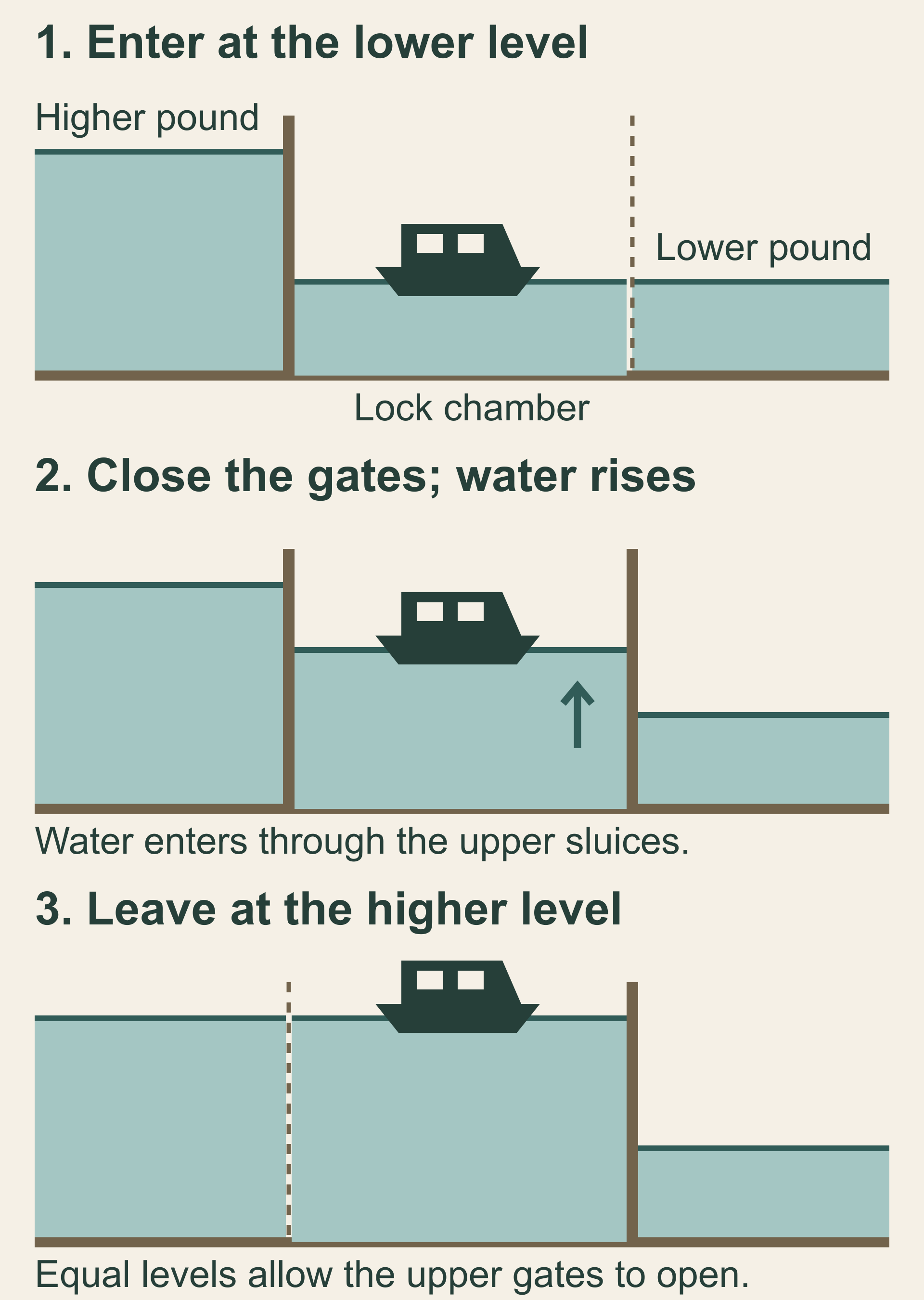
For a first trip, use the Canal & River Trust's lock guidance, your hire handover and the instructions at the particular lock. This diagram explains water levels; it is not a complete operating procedure.
What a canal lock is
The Canal & River Trust puts it plainly: a lock is a stretch of canal blocked off at each end by solid gates, opened or closed to let water fill or drain from the chamber between them. That chamber is the lock. The stretch of canal between one lock and the next is a pound, and the water in it sits at one level.
Canals cannot run uphill, and Britain isn't flat. Locks are how a canal climbs a hill in steps, each step the height of one chamber.
How locks are built and worked
Every lock follows the same sequence, and knowing the parts makes each step easier to follow from the towpath or the boat.
How a lock works, step by step
The Trust describes the sequence as three moves: the boat moves in, the gates close and the chamber fills, and once the water is level the far gates open and the boat moves out. In practice, going uphill:
- The chamber is emptied to the level of the low side, and the bottom gates opened.
- The boat goes in and the bottom gates are closed behind it.
- With the lower paddles closed, water is admitted through the upper sluices, controlled by the paddles. The boat rises with the water.
- When the level inside matches the level above, the top gates can be opened and the boat cruises out.
Going downhill is the same in reverse: fill the chamber to the high side, take the boat in, close up behind, then wind the bottom paddles and let the water out. Nothing pumps. Every lock operation moves a chamber of water downhill by gravity, which is why the network needs reservoirs feeding the summits.
The parts, in the order you meet them
- Gates. Usually mitred — two leaves meeting at an angle that points upstream, so water pressure pushes them shut. Some locks have a single gate at the top end.
- Paddles. The sliding covers you wind up with a windlass. They uncover the sluices.
- Sluices. The openings water flows through, in the gate or in a culvert around it.
- The chamber. The lock itself, sized to the boats the canal was built for — on a narrow canal, about 7ft wide and 72ft long.
- The cill. A ledge at the top-gate end, marked on the lock side. Going down, a boat that drifts back onto it can catch its stern as the water falls. Keep the boat clear of the cill and gates throughout. Slippery edges, moving water and snagged ropes or fenders also need attention.
Pound locks, staircases and flights
- Pound lock. The standard type described above — a chamber with gates at both ends. It replaced the older flash lock, which was little more than a removable barrier that released a "flash" of water for a boat to ride.
- Lock flight. Several locks in a row, each with its own pound between them. You work them one at a time.
- Staircase. Locks sharing gates, so the top gate of one is the bottom gate of the next, with no pound between. They must be worked in the right order and are usually signed, sometimes staffed in summer.
The mitre gate is not a modern invention. The Trust credits the double mitre lock to Leonardo da Vinci in the 15th century, and notes the first lock with gates at both ends was built in Holland in 1373. The gates you wind open on a Tuesday afternoon are a Renaissance design.
Working locks in practice
Time and crew matter more than anything else once you reach a lock, so these two questions come up first.
How long does a lock take?
The Inland Waterways Association's planning rule is three miles an hour plus ten minutes for each lock — six locks an hour. That is the number to plan a day around, and it is why boaters count locks rather than miles. A fifteen-mile day with two locks is a gentle cruise; a six-mile day through a flight of eighteen is a day's work.
With a good crew, locks close together and nobody coming the other way, it is quicker. Single-handed, or queueing at a popular flight in August, considerably slower.
Can you work a lock on your own?
Yes, and plenty do. Single-handing means securing the boat while you work the gates and paddles, which is why solo boaters develop a routine and a long centre line. It is slower and it is harder in wind. The Trust's Boaters' Handbook is the standard reference for doing it safely, and worth reading before your first flight rather than during it.
Locks are free to use and, on most of the network, self-operated — you work them yourself with a windlass. Some heavily-used or complex sites have lock keepers on duty in season, and staircases sometimes do too.
Locks today and tomorrow
Locks are still working structures, and they carry maintenance needs and a bit of history alongside the daily boat traffic.
Are canal locks still used?
Constantly. The freight traffic the canals were built for has gone, but the locks are worked every day by boaters, and the navigation authority maintains them as a live network rather than a museum.
Lock gates last about 25 years
This is the detail that surprises people. Lock gates are wooden and sit in water permanently, so they wear out and are replaced on a cycle — the Canal & River Trust gives the working life of a gate as around 25 years. Winter stoppages are largely gate replacement, done in the closed season with the pound drained.
A place to remember, if you wish
A favourite lock or stretch of canal can be a subject for a personal print. If you have your own photograph, you can print the original or choose an optional illustrated treatment below. This is a keepsake choice, separate from the practical lock guidance.
Where to go next
- What to take on a canal boat holiday — the practical list, including the lock kit people forget.
- Life on a narrowboat — how the locks fit into the rhythm of a year.
- Buying a narrowboat — if the flight has given you ideas.
- Living aboard — moorings, costs and the shape of a boating year.
- How to steer a narrowboat — the handling that gets you into the chamber straight.
- How far you get in a day — why a lock flight, not the speed limit, sets the range.
- English canal maps: which map to use, and the boat sizes the Trust publishes.