In short. Get a survey every time without exception — the Canal & River Trust puts one at roughly £10 to £14 per foot, which is the best-value money in the whole process. Budget for the annual running costs before you commit rather than after. On price, be careful what you read: no authority publishes narrowboat values, so the per-foot rules of thumb in circulation come from people who sell boats.
Choosing, surveying and paying
These sections follow the order most first-time buyers work through, from the purchase itself to the survey and the annual bills.
What a narrowboat costs to buy
Price tracks age, hull condition, fit-out quality and length, roughly in that order. The broad bands, as the market sits in 2026:
- Project boats. The cheapest end: boats needing overplating or a fit-out. They suit someone who can do that work or budget for someone who can, and they are priced accordingly.
- Sound secondhand. Boats you could cruise away in, priced by length, age and the quality of the fit-out. Brokers list current asking prices, and that is the number to work from; if one is markedly cheaper than comparable boats of the same length, assume the difference is going into the hull or the fit-out sooner or later.
- Newer and well-specified. Above the per-foot baseline: recent hulls, sensible layouts, a fit-out you would not rush to change.
- New builds and sailaways. Substantially more again, finished to order.
- Where these figures come from, honestly: no navigation authority or trade body publishes narrowboat price data. The per-foot rule of thumb circulates among brokers and the boating press, who have an interest in the number, and nobody publishes completed-sale prices. Treat any range — including this one — as orientation, and set your budget from current listings and a survey, not from a guide.
Draught decides where she can physically go — canals are shallower at the edges than the headline depth suggests, and a deep-draughted boat grounds where a shallow one passes. Length changes everything downstream: mooring is usually priced per foot, and so is blacking. A 57ft boat costs meaningfully less to keep than a 70ft one, and it turns in more places.
How to buy one for the first time
- Decide how you will use it before you look. Continuous cruising, a home mooring at weekends, or living aboard full time are three different boats and three different budgets. Our guide to life on a narrowboat covers what each involves.
- Hire one for a week first, ideally in bad weather. Every experienced boater gives this advice and it is the cheapest money you will spend. A wet February week tells you more than a fortnight in July.
- View several before you get attached to one. Listings flatter interiors and say little about steelwork.
- Get the survey. Always. Details below.
- Negotiate on the survey findings, not the asking price in isolation. The report is your evidence.
- Sort licence, insurance and mooring before completion. You can't legally keep a boat on the network without a licence, and insurers want a valid Boat Safety Scheme certificate.
Stern types, and why it is the first thing to decide
Narrowboats come in three stern layouts and the choice shapes how the boat is used more than any other single feature:
- Traditional stern. A small deck, engine under your feet in the engine room, cabin space maximised. Best for a couple or a single-hander who wants the length inside. Steering is a solitary business.
- Semi-traditional. A compromise: enclosed sides, room for two or three people to stand with the steerer, without losing much cabin. The most common choice for liveaboards who still want company at the tiller.
- Cruiser stern. A large open deck, room for several people and a couple of chairs, at the cost of interior length. Popular with families and anyone who cruises socially in summer.
Alongside stern type, note the engine. A modern diesel is cheaper to service and easier to get parts for; a vintage engine is charming, loud, and a commitment. Ask when the engine was last serviced and whether the boat has a bow thruster — useful on a long boat in wind, one more thing to maintain.
Moorings: the decision that sets your annual cost
Where the boat lives matters more to the budget than what you paid for it:
- Residential mooring. Permission to live aboard at a fixed address, with post, utilities and often parking. Scarce, expensive, and worth securing before you buy if living aboard is the plan.
- Leisure mooring. A berth in a marina or on a canalside bank for a boat you visit. Cheaper, but you may not legally live on it full time.
- Continuous cruising. No mooring fee at all, in exchange for a genuine obligation to move — a progressive journey around the network, not shuffling between two spots. The navigation authority monitors this and licences have been refused over it.
- End-of-garden and farm moorings. Sometimes available privately, usually informal, always worth checking the planning position before relying on one.
A Boat Safety Scheme certificate is required for a licence and is renewed every four years — it is a safety check on gas, fuel, electrics and ventilation rather than a survey of the hull, and passing one says nothing about whether the steel is sound.
The survey, and why it is not optional
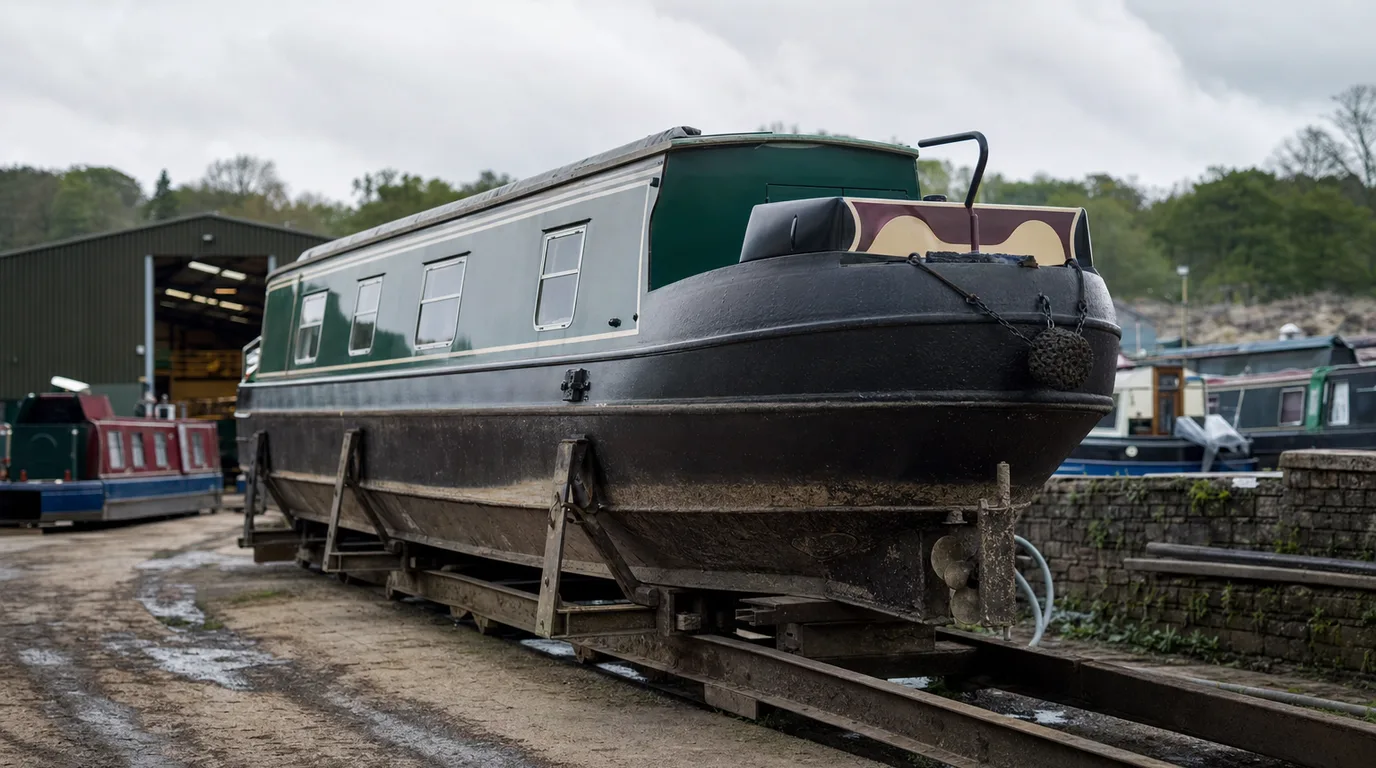
A pre-purchase survey takes the boat out of the water and checks hull thickness with an ultrasonic meter, along with the baseplate, the anodes, the steelwork around the waterline and the state of the blacking. It also covers engine, gas, electrics and the Boat Safety Scheme items.
What it is buying you is the hull number. Steel thins with age, and overplating a tired hull is a four-figure job at best.
The Canal & River Trust publishes what a survey should cost: around £10 per foot for a hull survey, or £12 to £14 per foot for a full survey — so roughly £550 for a hull survey on a 55-footer and £680 for a full one, with a valuation alone charged at about £250. Against a boat costing tens of thousands, that is the line item first-time buyers are most tempted to skip. Do not.
What it costs to run
The purchase price is the part people plan for. The annual cost is the part that surprises them:
- Licence — priced by length and width, and by whether you have a home mooring. Exact numbers and the discounts worth asking about are in our narrowboat licence cost guide.
- Mooring — the biggest variable by far. A residential mooring near a city is a different order of money from a rural leisure berth, and continuous cruising removes the cost entirely at the price of moving every fortnight.
- Insurance — modest, but requires a current Boat Safety Scheme certificate. The Canal & River Trust confirms certificates are required every four years and that a boat cannot be re-licensed without a valid one.
- Blacking — steel boats are usually taken out of the water for blacking every two to three years, priced per foot.
- Engine servicing, gas, coal and diesel — these scale with how much you cruise and how cold the winter is.
Is buying a narrowboat a good investment?
Treat it as a purchase rather than an investment. Brokers and marinas commonly say well-kept boats hold their value, and there is something in that — a known builder with a sound hull and a sympathetic fit-out does resell strongly, and boats are routinely kept twenty years or more. But that argument comes from people who sell boats, and "holds its value" is doing quiet work: it means the boat depreciates slowly while you spend money on it every year to keep it that way.
The honest position is that nobody publishes audited resale data for narrowboats, so anyone quoting you a confident number — including a broker — is estimating. What is not in doubt is the annual cost: licence, mooring, insurance, blacking and servicing continue whether you cruise or not.
What it does buy is a way of living: a home with a changing view, a hobby that fills every weekend, or a cheaper route to owning somewhere outright than bricks and mortar in the same region. Those are good reasons on their own terms.
The downsides nobody puts in the brochure
- Winter is real work. Solid fuel means carrying coal, emptying ash and lighting a stove before the cabin is warm. Condensation runs down steel.
- Water and waste are finite. You fill a tank and empty a toilet, on a schedule, in all weather.
- Post and deliveries are awkward without a fixed address — marina office, family, or a forwarding service.
- Continuous cruising is a legal obligation, not a lifestyle label. Without a home mooring you must move, and the navigation authority checks.
- Maintenance never stops. Something aboard is always slightly wrong. Owners who enjoy that are happy; owners who wanted a finished product are not.
How long does a narrowboat last?
Longer than most people expect, given upkeep. Lifespan is a function of maintenance rather than age: blacking on schedule, anodes replaced, water kept out of the bilge. It is why a survey reads hull thickness rather than the build date. The detail is in how long a narrowboat lasts.
Where to buy and what follows
Once the decision is made, the remaining questions are where to find a boat and what to do after the sale.
Where people buy
Two independent guides worth reading alongside this one: the Canal & River Trust on buying a second-hand boat, and the Inland Waterways Association on buying a boat for UK canals and rivers.
Brokerages handle most secondhand sales and offer some process protection; private sales are cheaper and put the diligence entirely on you. Boat shows and marina noticeboards still sell boats, particularly at the older end. Whichever route, the survey is the same non-negotiable step — and a seller who resists one is telling you something.
After you buy: the name
The first thing most new owners do is decide what she is called; the second is have it lettered. It is the one detail that is entirely theirs, and it matters more than people expect before they own a boat.
And once she is yours and out on the water, the other thing owners tend to want is a picture of the boat itself — the hull, the livery, the stretch of canal she works — rather than only the name.
Where to go next
- Narrowboat licence cost — the annual number, in detail.
- Life on a narrowboat — what the year looks like.
- Choosing a narrowboat name — the categories, the register and the rules.
- Narrowboat, canal boat or barge? — the terminology, correctly.
- Wide beam narrowboats: where they can go, the licence surcharge and the tunnels that need booking.