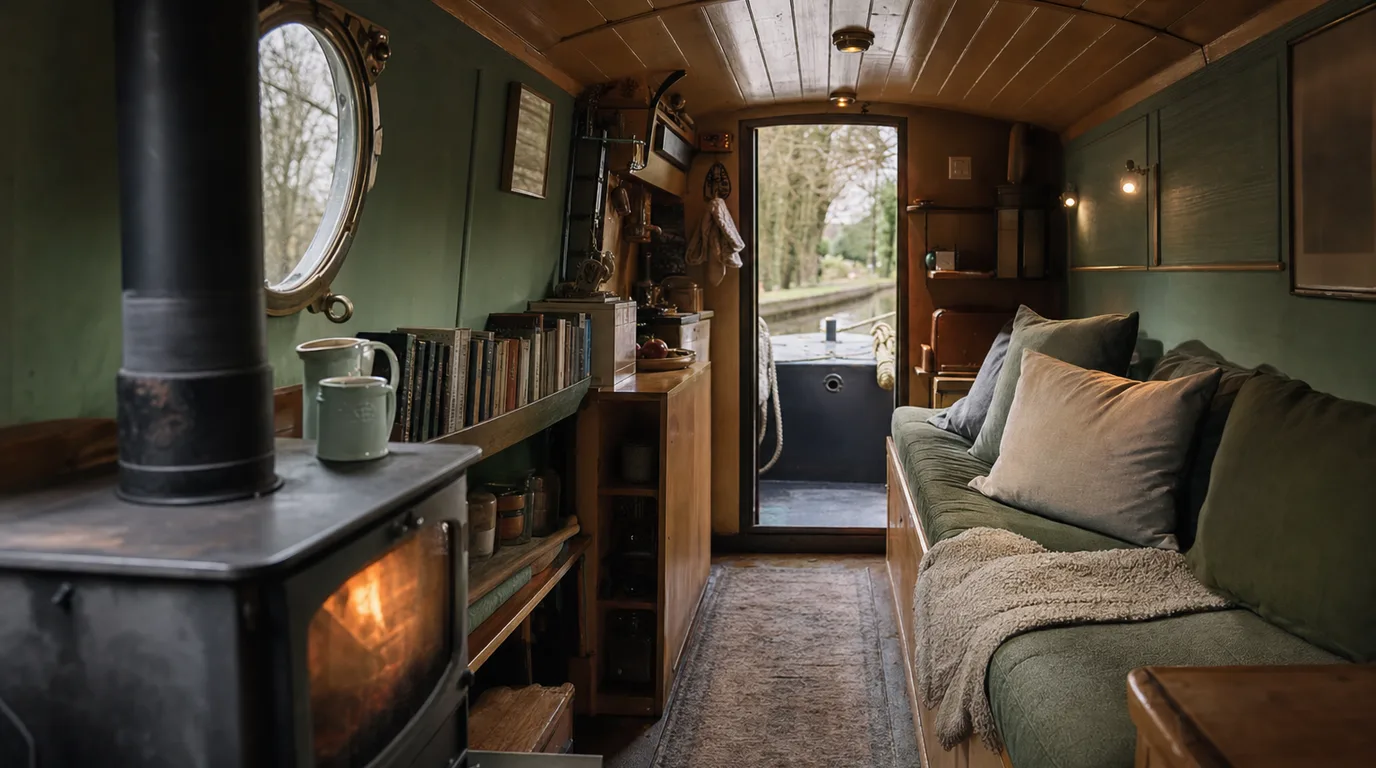
What is a narrowboat, exactly
A narrowboat is a long, slim, flat-bottomed boat designed to fit the narrow locks of Britain's industrial-era canal network. Most run between 30 and 70 feet long and exactly 6'10" wide, that width is the constraint everything else is built around.
They were originally cargo boats, hauling pottery, coal, lime and grain across the country before the railways. The canals fell into disrepair after WWII, were almost lost to filling-in in the 1960s, and were saved by a small army of volunteers who kept them navigable. Today they carry leisure traffic and a few thousand full-time residents, but the boats themselves are largely unchanged.
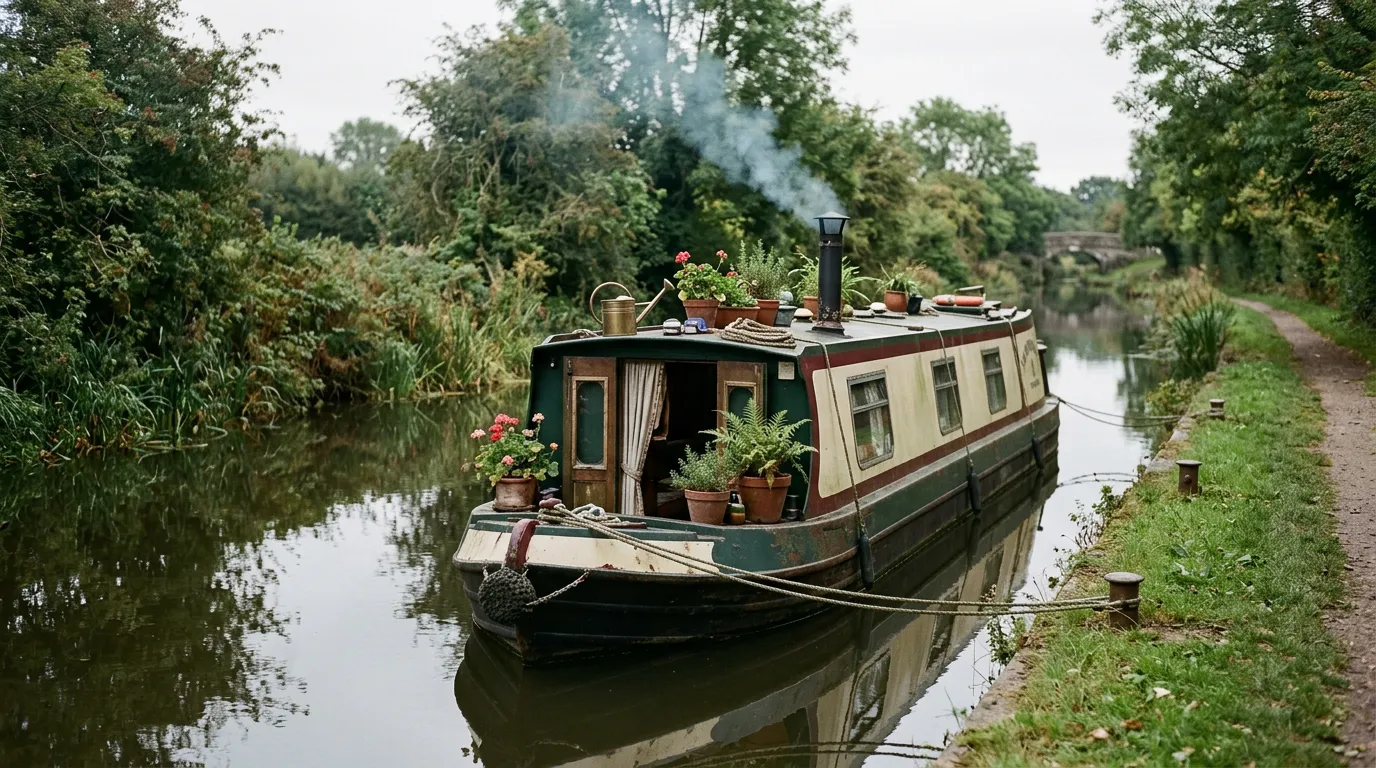
What life on a narrowboat is actually like
Day to day, life on a narrowboat is slower, smaller, and far more weather-aware than life ashore. The width (exactly 6'10") is the fact everything else bends around: storage is a constant discipline, and nothing comes aboard without earning its place. Water and power are finite. You fill a tank and watch a gauge rather than turning a tap; you charge batteries from the engine, solar, or a hook-up rather than flicking a switch without thinking. None of this is hardship once it's habit, it's just attention.
What you get back is the part that's hard to put a price on. The view changes when you want it to. Mornings are quiet in a way a street never is. The towpath community is unusually generous: boaters help each other through locks, lend tools, and pass on the local knowledge of where to moor and where not to. A canal boat is also called a narrowboat by most people, and the two words get used interchangeably on the water: more on that in our short guide to what a canal boat is called.
The three kinds of narrowboater
Boaters fall into three rough groups. The differences matter because they shape the licence, the costs, and the rhythm of life.
Liveaboards with a permanent mooring
Live full-time on the boat, but pay an annual mooring fee for a fixed berth: a marina, a basin, a stretch of towpath. The boat stays put for most of the year and goes cruising for weeks at a time. Council tax usually applies if the mooring has a residential designation. More on liveaboards →
Continuous cruisers (CCers)
Live full-time on the boat without a permanent mooring. Move every fortnight under the rules of the Canal & River Trust's continuous cruising licence, the boat must travel "place to place" through the year. No mooring fee, no council tax, but a fortnightly move whatever the weather. More on CCers →
Leisure boaters / weekenders
Don't live on the boat. Use it for holidays, weekends, the occasional summer fortnight. The boat sits at a leisure mooring most of the year. Probably also own a house. Most British narrowboaters are in this group.
The rhythm of the year
The boating year is shaped by three things: the weather, the licence, and the stoppage list. Stoppages are when the Canal & River Trust closes a stretch for repairs: usually November to March, usually well-advertised.
- March to October, the cruising season. Long days, busy locks, plenty of company. Most leisure boaters do all their cruising in this window.
- November to February, the slow months. Quieter canals, bare hedgerows, more pubs with fires. Liveaboards rotate around to where the wind is kindest.
- The Christmas freeze, about a week most years where everything ices over. Boats stay still. Stoves stay on. Reading happens.
What it costs, and why we won't give you a table
Every liveaboard guide prints a tidy annual budget. We had one here too, and we have taken it down, because almost none of those numbers can be stood up: the Trust publishes no licence price list, the Boat Safety Scheme publishes no examination fee, and mooring, fuel and maintenance vary so widely by region, boat and winter that a figure would be a guess in a table's clothing.
What is worth knowing is which lines are fixed, which are published, and which you have to go and ask about.
- Licence — required, and calculable exactly. Charged by length and width, then surcharged if the boat has no home mooring and again if it is wider than a standard narrowboat. Both surcharges rise every April to 2028. Put your boat's real numbers into the Trust's calculator and you get the actual figure rather than an average. We set out how the pricing works in full.
- Insurance — a published minimum. The Trust requires third-party cover of at least £2,000,000 before it will licence the boat. That floor is a fact; what you actually pay depends on the boat and the insurer, so get quotes.
- Boat Safety Scheme — fixed interval, open fee. A certificate on a fixed cycle, at a price nobody publishes: examiners set their own. Budget for it as a lump rather than a monthly. The interval and what moves the number are in what a narrowboat licence costs.
- Mooring — the biggest variable by far. Nothing if you cruise continuously, and a serious annual sum for a residential berth somewhere popular. This single line moves the budget more than the rest put together, so price the specific marinas you would actually use before committing to anything.
- Fuel and heating. Diesel for cruising and the engine, and coal or gas for the stove. Driven by how far you cruise and how cold the winter is, which is why quoted averages are close to meaningless. A season aboard tells you your own number.
- Maintenance and blacking. Ongoing upkeep, the hull blacked every few years, and the occasional unwelcome surprise. Budget for it as a lump that lands irregularly rather than a smooth monthly figure.
- Buying the boat. The spread runs from a tired short boat needing work to a new bespoke widebeam, and brokers list current asking prices publicly. Look at real listings for the length and condition you want; that is a live market, and any number we printed here would be out of date by the time you read it.
None of that is evasion. It is the difference between a budget you can defend to a mortgage lender and one assembled from someone else's blog.
Is living on a narrowboat worth it?
The honest answer is that it depends on what you're trading. Against bricks and mortar, the cost of living is low: there's no rent or mortgage once the boat is paid for, and a continuous cruiser pays neither mooring fee nor council tax. Against a house, you give up space, easy storage, and the convenience of mains everything. People who thrive aboard tend to value freedom and simplicity over square footage; people who miss a spare room and a dishwasher tend not to last a winter.
For most who stay, the maths and the mood both land on the right side: a smaller, cheaper, more deliberate life, with a changing view and a community that comes with it. The one piece of advice every boater gives: spend a few weeks aboard, ideally including some bad weather, before you buy. A hire week in February tells you more than a summer fortnight ever will.
The unwritten rules
A short list of things the books don't tell you but every boater learns within a season.
- Tickover past moored boats. The wash from a boat doing more than walking pace breaks fenders.
- Close paddles slowly behind you. Slamming gates damages gates. The volunteer lock-keepers see everything.
- Wave at the towpath. Cyclists, walkers, dog-walkers: they're all part of the canal's social fabric.
- Help with locks if you're working as a pair. Single-handed boaters are owed a hand.
- Don't moor on a winding hole. Don't moor on a water point longer than the time it takes to fill. Don't moor in front of a bridge.
- If you smell smoke and don't know why, it's worth investigating. Stove fires happen.
Where to read more
- Canal & River Trust, the navigation authority for most of the network. Licences, stoppages, all the official guidance.
- Narrowboat Magazine, quarterly. Long-form, opinionated, well written.
- Towpath Talk, newspaper-format, monthly. News, classifieds.
- Steve Haywood, Narrowboat Dreams: the most readable memoir.
Living aboard is mostly a question of what you do with the space. For that side of it, see our narrowboat interior design ideas.
Written by Craig Fearn, Narrowboat Gifts. Last updated .