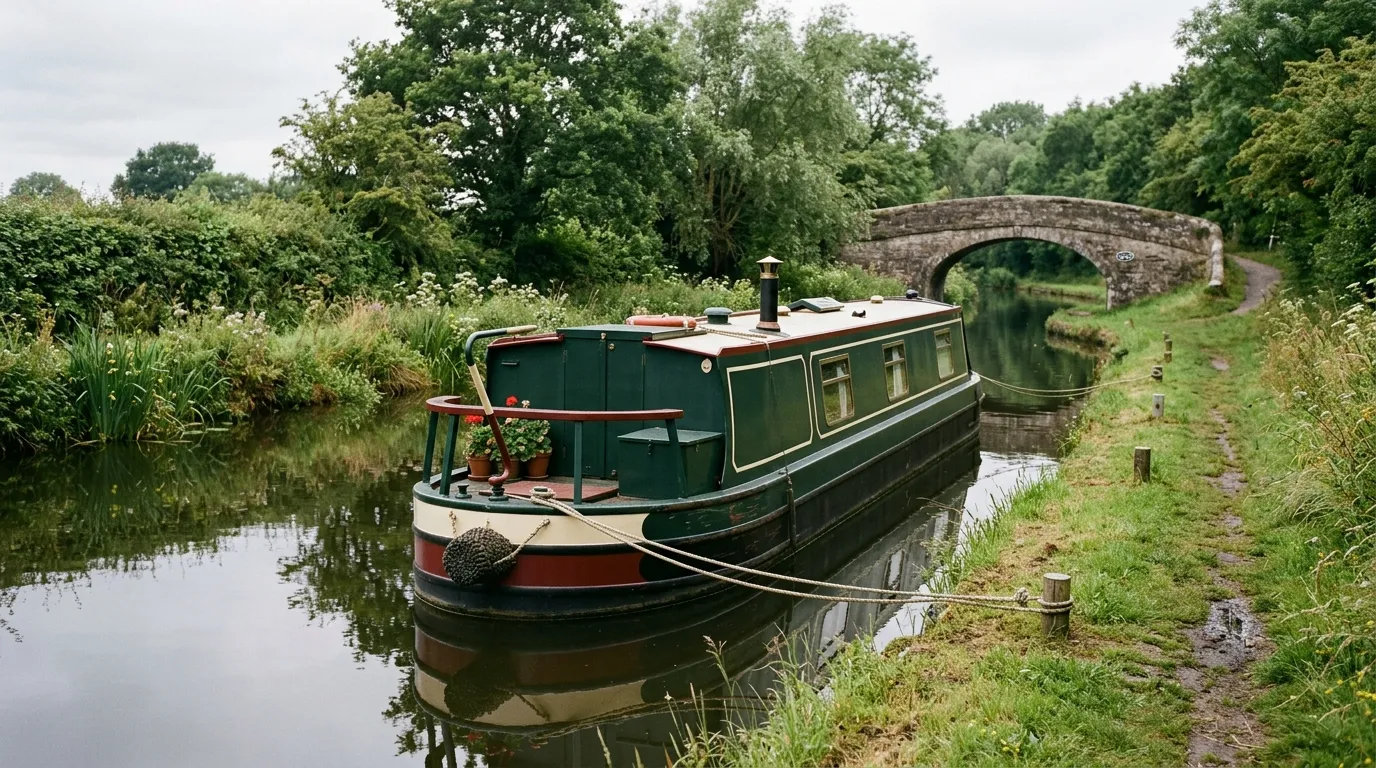
In short. A narrowboat is a long, slim steel boat built to slip through the narrow locks of Britain's canal network: no more than 6 feet 10 inches wide, traditionally up to 72 feet long. Two centuries ago they hauled coal, timber and lime for a living. Today almost every one is a holiday boat or a full-time home. If you're picturing a painted boat with a name on the side, moving at walking pace with someone leaning on the tiller, that's a narrowboat.
Size and naming
These sections cover how big a narrowboat is, why it is built so narrow, and which word describes it best.
Why is a narrowboat 6 ft 10 in wide?
Because the locks are. When the narrow canals were cut in the late 1700s, the lock chambers were built about seven feet across to save water, brick and money. The boats were built to match, with an inch or two to spare on each side. The trade died, the canals stayed exactly as they were, and the boats kept the gauge because there was nowhere wider to go. That single dimension (6 ft 10 in) is the whole reason a narrowboat looks the way it does. Everything else follows from being long and thin because it has to be.
How long is a narrowboat?
Anywhere from around 30 feet to the full historic 72. Most leisure boats sit between 45 and 60 feet: long enough for a proper bedroom, a bathroom and a saloon, short enough to handle single-handed. There's a catch worth knowing before you buy: a boat much over about 57 feet can't cruise the whole connected network, because some of the northern locks are shorter than the southern ones. Boaters call 57 ft the "go-anywhere" length. Go longer and you gain a room but lose a few hundred miles of canal you'll never be able to reach.
Narrowboat, canal boat or barge: which word is right?
All three get thrown around, and only one is usually right. "Canal boat" is the safe umbrella term for anything built for the inland waterways. "Narrowboat" is the specific slim type you mean. "Barge" properly means a broad cargo craft: fine for a Dutch barge, wrong for a painted 57-footer, and a boater will gently put you right. We've pulled the whole tangle apart in a separate guide on what a canal boat is called; the short version is that "narrowboat" is one word and never an apology.
How the boat works
Next comes the practical side, covering what the hull is made from, how the boat is powered and how quickly it travels.
What is a narrowboat made of, and how does it work?
Steel, welded and painted. A modern narrowboat is built from steel plate: a thick baseplate on the bottom (often 10 mm), thinner sides and cabin (6 and 4 mm are common), all welded into one hull and then ballasted with paving slabs or steel so it sits level in the water. There's no keel and no sail. An inboard diesel engine turns a single propeller, and you steer from the back with a tiller: a long steel bar you push the opposite way to where you want to go, which everyone gets wrong for the first hour.
The stern comes in three shapes, and boaters have opinions about all of them. A traditional stern has a tiny standing space and a big engine room, closest to the old working boats. A cruiser stern has an open deck where several people can stand: sociable, less cosy in January. A semi-trad splits the difference. Down below, the layout runs bow to stern in a fixed order because the boat's too narrow to do anything else: you walk through the boat, not across it. The prettiest part of a traditional boat is the back cabin, the boatman's living quarters, still fitted out with the folk-art roses and castles the old families painted on everything they owned.
How fast does a narrowboat go?
Walking pace, and that's the point. The Canal & River Trust states it plainly: “On our network the speed limit on most canals is 4 miles per hour. On most rivers it's 6 miles per hour” (Canal & River Trust on speed limits and etiquette, read 10 September 2026). Even 4 is too fast past moored boats: the wash pulls at their lines and the crews inside feel it. You don't take a narrowboat out to get anywhere quickly. A journey that's an hour by car can be three days by water, through a couple of dozen locks, and the slowness is the entire reason people do it. Nobody buys a narrowboat to save time.
Living aboard and ownership
Here we look at everyday life on board and at the ownership costs that most newcomers want explained before they commit.
What's it like to live on a narrowboat?
Tighter than a flat, closer to the weather, and quietly addictive. Tens of thousands of people live aboard full-time in Britain, split into two camps. Some have a home mooring: a permanent spot they pay for, with an address and often power. Others are continuous cruisers, with no fixed berth at all, obliged to move to a new stretch of canal at least every 14 days. Either way, life shrinks to what fits: a 6 ft 10 in kitchen, a solid-fuel stove, water in a tank you fill up every week or so, and a genuine relationship with your own electricity. It suits some people completely and drives others back to bricks within a year. If you want the texture of it rather than the theory, our guide to narrowboat life goes further, and liveaboard gifts is where people land when they're buying for someone who's made the leap.
How much does a narrowboat cost?
More than people expect, and across a wider spread than any average can carry. At the bottom sit older steel-hulled project boats needing survey work; in the middle, well-maintained ready-to-cruise boats priced by age, length and fit-out; at the top, a commissioned new build with a bespoke interior, made to order rather than off a shelf. Brokers publish current asking prices, so look at live listings for the length and condition you want - and read why there is no meaningful average before you anchor on a figure from anywhere else. Then come the running costs, which the sale price never mentions: an annual Canal & River Trust boat licence (priced by length and width), a mooring if you want one, insurance, a Boat Safety Scheme certificate every four years, and maintenance that never stops. The Trust's own guide to buying a second-hand boat is the sober read to do before the romantic one.
Routes and the name on the side
The last two sections explain where a narrowboat is allowed to travel and why the painted name matters to boaters.
Where can a narrowboat go?
Across roughly 2,000 miles of connected canals and rivers, most of it looked after by the Canal & River Trust. That network is the reason the 6 ft 10 in gauge still matters: keep to it and almost the whole system opens up, from the Llangollen in Wales to the Kennet and Avon in the south, stitched together by famous circular routes (the Cheshire Ring, the Four Counties Ring) that boaters cruise over a fortnight's holiday. A wide-beam boat, roomier but broader, is stuck at the first narrow lock. The narrowboat's dimensions cost you space and buy you reach, and on a network built for one exact width, reach wins.
Why does the name on the side matter so much?
Because on the water, the name is the boat's identity: the thing lock-keepers announce you by and other boaters remember you as. It's chosen deliberately, signwritten by hand or in vinyl on each side of the cabin, and it stays with the boat when it's sold. If you're naming one, our guide to narrowboat names covers the seven traditions worth knowing (and the puns worth avoiding). Once it's chosen and painted, the name is the one thing worth keeping off the water too: which is the whole reason this site exists. We set it in type and put it on the wall, as canal boat gifts and personalised prints for narrowboat owners.