Canal boat signwriting vs. roses and castles
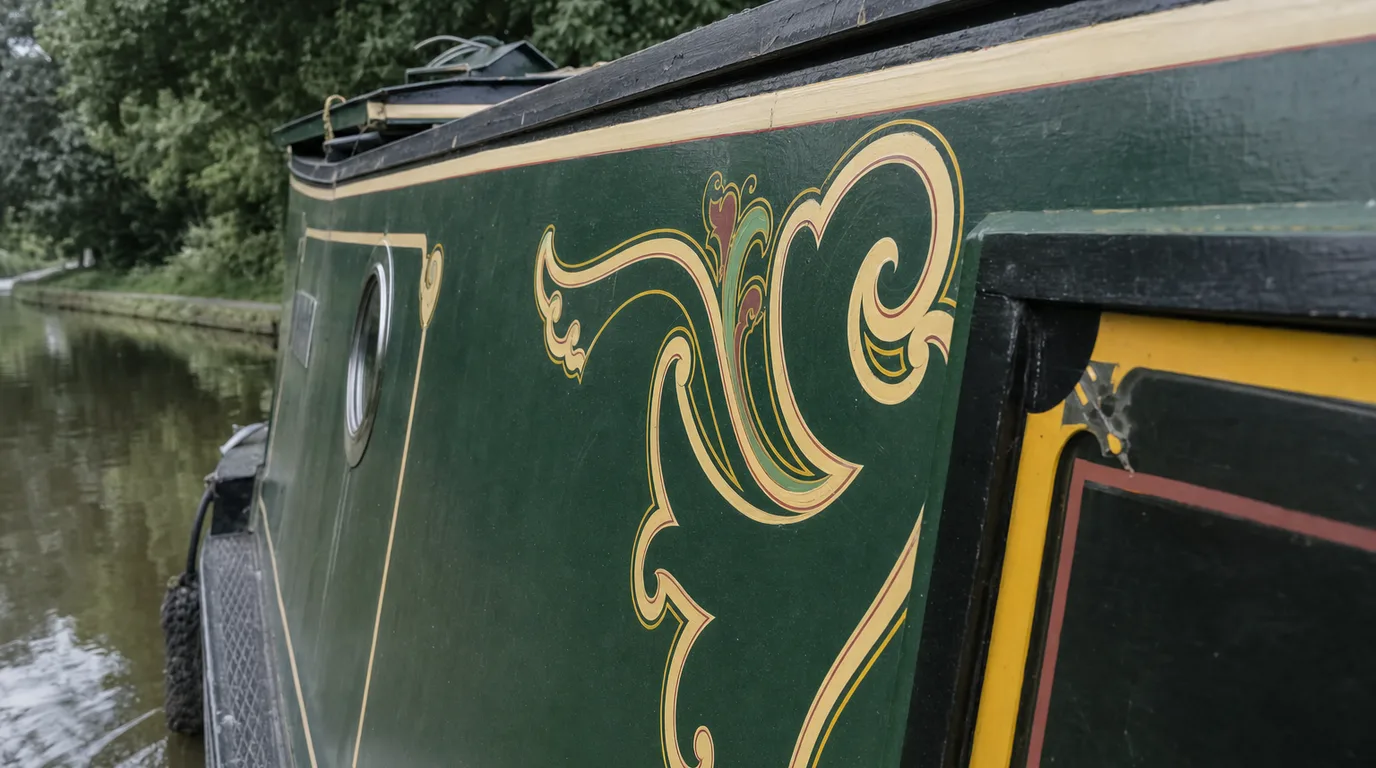
Two crafts share a narrowboat's cabin side and they're often confused. Roses and castles is the decorative folk painting: the flowers, the castles, the painted Buckby can. Where that decoration came from is not documented, and on a working boat it ran well past the cabin panels, onto the water can, the harness and the furniture (the Trust's account of the decorative tradition). Signwriting is the lettering: the boat's name, its index number, the owner or carrying company, set in enamel paint in a precise, readable hand. A boat might be decorated by one painter and lettered by another; the signwriter's job is legibility and proportion, not ornament.
How a boat name is traditionally lettered
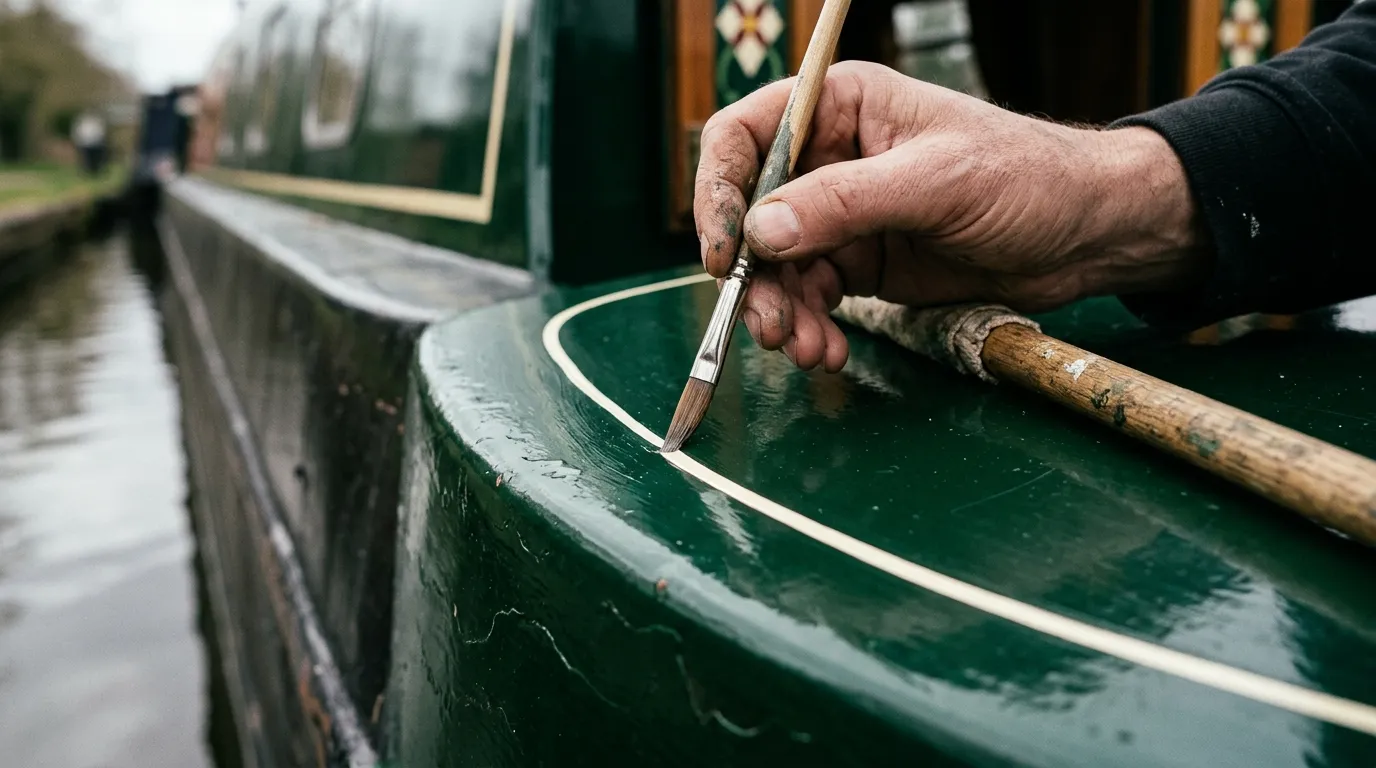
The convention is a serif letterform with a hard drop shadow and a contrasting outline: typically cream or yellow lettering shaded to one side, sitting on a bottle-green or oxblood cabin side. The shading and outline aren't decoration for its own sake: they make the name read cleanly from the towpath and across the width of a lock, in flat canal light. There's no single "canal boat font", because the letters are drawn by hand to fit the space rather than set from a typeface: a good signwriter spaces the name optically so it looks even, not measured.
Getting your boat signwritten
For the real thing you want a specialist canal signwriter, and the one decision that matters before any of the rest is paint or vinyl. Self-apply vinyl is far cheaper and it is not signwriting: what you are paying a signwriter for is a hand that can space letters by eye. Ask to see examples before anything else. What it costs is its own question, and we answer it in how much narrowboat signwriting costs; how to find someone is further down this page.
A printed name sign, the indoor counterpart
Signwriting lives on the hull. A printed boat name sign is its counterpart indoors: the same name, in the same tradition of shaded serif lettering and the bottle-green-and-oxblood palette, but on the cabin wall, in the house, or as a gift to the owner. It's not a replacement for the painted name; it's the version you can hang, post, and give.
We make it as a personalised name print (from £14.99), a framed print (from £69.00) ready to hang, or a canvas (from £51.49) that reads most like a painted panel. Each carries the boat's name, the waterway it works, and a date that mattered. See the full range under canal boat gifts, or our guide to choosing a narrowboat name if the boat isn't named yet.
Vinyl vs. hand-painted, honestly
Most people weighing up a name come to the same fork: cut vinyl lettering, or a signwriter and a brush. They're not the same thing, and it's worth being straight about the trade.
Vinyl wins on cost and speed. A self-apply set is a fraction of hand-lettering, turns up in the post, and goes on in an afternoon with a squeegee and a steady hand. From the towpath, a clean vinyl name looks fine. The catch is what happens over time and up close. Vinyl sits on top of the paint rather than in it; the edges lift where they catch a fender or a lock wall, the colour chalks and fades after a few summers of UV, and peeling a tired set off leaves a ghost on the cabin side. Up close it reads as a sticker.
Hand-painted signwriting is the other end, and costs accordingly - a proper job means both sides plus the stern, shaded and outlined. For that you get lettering that's part of the paint, holds its colour for years, takes a touch-up without a visible seam, and reads as a real canal boat rather than a decal. So: vinyl for a stop-gap, a tight budget, or a name you might change. Hand-painting when you want the boat to look the part and keep its value. Be wary of anyone selling vinyl as "signwriting", it isn't.
What goes on the boat besides the name
A signwriter does more than the name. A boat carries its name on both cabin sides, and traditionally again across the stern, so it reads whether you are meeting it, passing it, or following it through a lock. Two of those are not a matter of taste: the Canal & River Trust asks boaters to “always display your boat name and boat index number on both sides of your boat”, painted, in vinyl, or on a card in the window (Canal & River Trust on naming your boat, read 10 September 2026). The stern is convention rather than requirement.
Beyond the essentials, tradition allows for more. Some boats add a home port or mooring, some the owner's or carrying company's name in the old working-boat style, and many sit the lettering inside a painted panel: a bordered block, often picked out in a contrasting ground, that frames the name and lifts it off the cabin side. The grounds themselves run to the canal palette: bottle green, oxblood red, black. Not cream, cream is the lettering colour, shaded and outlined against those darker grounds, never the background it sits on. A signwriter will set all of it out so the proportions hold together rather than competing.
Choosing a signwriter
The gap between a competent signwriter and an excellent one is small on paper and obvious on the water. Ask to see a portfolio (not a logo they designed, but boats they've actually lettered) and look at two things in particular. Spacing: do the letters sit evenly, with the gaps optically balanced rather than mechanically equal? And the shadow: is the drop shadow consistent in angle and weight all the way along, or does it wander? Those two tells separate a brush that knows what it's doing from one that doesn't.
Many of the best canal signwriters work the festival circuit (the gatherings at Braunston, Crick and the like) or out of yards along the network, so a recommendation from your marina or a boat you admire is worth chasing. Most will quote from a photo of the cabin side and the name you want, and a good one will talk you through letterform, shading and the panel before lifting a brush. Cheapest is rarely the answer; the lettering is the first thing anyone sees.
Looking after signwriting
Enamel signwriting lasts years, but it's not fit-and-forget. A few habits keep it sharp:
- Sun is the enemy. UV fades reds and yellows fastest, so a boat that sits south-facing on a mooring will dull sooner than one under cover. A coat of wax over the lettering slows it.
- Wash the name gently. Grit and a stiff brush scratch the shadow and outline first, because they're the thinnest paint. Soft cloth, clean water.
- Touch up early. A signwriter can re-cut a faded letter or sharpen a shadow far more cheaply than redoing the whole name, catch it before it goes too far.
- Mind the blacking. When the hull's reblacked, the line where black meets the cabin side runs close to the lettering; make sure whoever's doing it cuts in cleanly and doesn't lap paint onto the name.
Treated this way, a hand-lettered name will outlast several rounds of blacking and still read clean from the bank: which is the whole point of doing it properly in the first place.
Written by Craig Fearn, Narrowboat Gifts. Last updated .