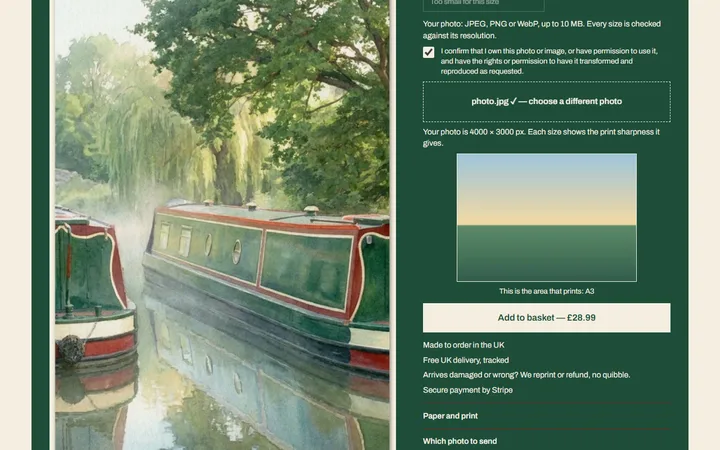
- One paper, archival. 250gsm uncoated off-white archival at every size: soft, neutral, and built to last.
- Measured, not guessed. When you upload, we work out the effective resolution of your file at every size we sell and refuse the sizes it cannot hold. You are never able to buy a print your photograph cannot fill.
- Printed as it stands. No retouching, no filter, no crop we have not shown you. What you approve is the file that goes to the press.
- UK delivery, 4–9 working days. Made to order and sent tracked, with free UK delivery.
Sizes
- A4 — a phone photo covers this comfortably
- A3 — the usual choice for one good shot of her
- A2 — holds up if the original was well lit
- 50x70 cm — suits an upright crop
- 70x100 cm — needs a large, sharp original
- 250gsm uncoated off-white archival at every size.
How big can your photograph go
A print is sharp when the file carries enough pixels across the finished size. At 300 pixels per inch or more a photograph is at its best. Below 140 we refuse that size rather than print it soft, and it cannot be chosen. Between those two the print is good, and gets better the closer to 300 you are.
In practice: a 12-megapixel phone photograph (4032 x 3024) covers A4 and A3 comfortably, reaches A2 with room to spare, and is close to the floor at 70 x 100 cm. A 24-megapixel camera file covers every size we sell. A picture saved from a messaging app or lifted off a social post is usually well under a megapixel, and that is the file that gets refused: it is the compression, not the camera, that has cost you the print.
You do not have to work any of this out. Upload the picture and the sizes it cannot hold are switched off before you can choose them.
Which photograph of her to use
- Bow-on at the mooring is the safest frame: the whole boat, the name readable, and a background that is water and towpath rather than parked cars.
- Mid-lock is the one people love and the one most often blurred. The boat is moving and the light in a lock is poor, so if you have a burst, pick the sharpest frame rather than the best composed.
- Flat, overcast light prints better than bright sun, which blows out cream panels and buries the shaded side of the hull in black.
- Leave room around her. A print is cropped to the shape of the paper, so a photograph filled edge to edge with boat loses her bow or her stern at some sizes.
When the picture you have is a poor one, the portrait version is the more forgiving route: a style takes the softness with it. And if the boat herself is not the point, the name print needs no photograph at all.