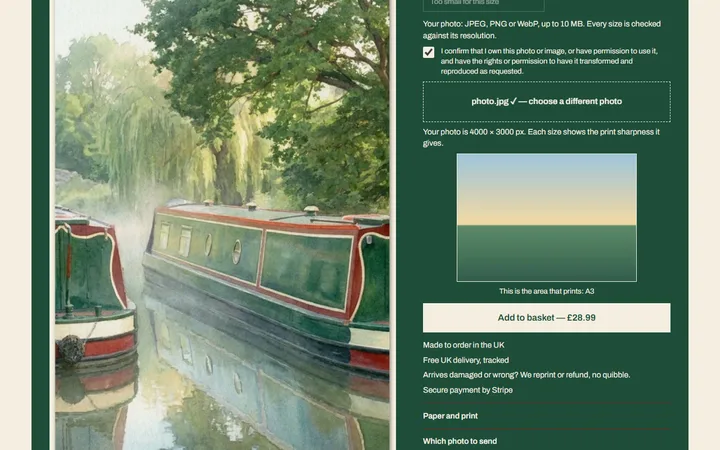
- Birch-faced plywood, 10mm. Gelato's product record names the stock “Plywood lined with a Birch outer layer”, printed with a horizontal grain direction. Frameless, light, and it belongs on a boat in a way glass does not.
- The grain is part of the picture. The ink is laid onto the wood rather than onto a white ground, so pale areas take the grain and dark ones bury it. A photograph with sky in it will show the board through the sky. That is the reason to choose wood, and the reason not to.
- Quality checked: No blurry prints. We grade your photo against each size and disable any it isn't sharp enough for, so the wood print arrives crisp.
- UK delivery, 4–9 working days. Made-to-order, ships boxed and tracked. Free UK delivery.
Sizes
- 300x400mm, 10mm lined plywood
- 400x500mm, 10mm lined plywood
Choosing a photograph that works with the grain.
Because the ink goes onto the wood, light areas show the grain and dark areas hide it. So the photograph decides how the finished piece looks. A shot with a pale sky will show the board through the sky, which some people love and others find distracting. A picture with dark water, a deep hull and green banks gives a richer, steadier result. Dusk and evening mooring shots do well, because the tones are low and the wood adds warmth.
Landscape suits the board.
The plywood runs with a horizontal grain, and the two sizes are 300x400mm and 400x500mm. A landscape photograph follows the lines of the grain, so the boat appears to sit on the wood. An upright picture works against it, with the grain running across the shape of the cabin. Keep the horizon level, since lines in the wood make a tilt more obvious.
- Pick a photograph with strong tonal contrast over one with soft, even grey.
- Avoid large areas of pale sky unless you want the board to show through.
- Keep fine detail to a minimum, because the grain competes with it.
Wood, paper or canvas.
Choose wood when you want the piece to feel at home in a timber cabin, not to look like a clean photograph. If you want exact colour and sharp lettering, a paper print is the more faithful route. If you want a softer finish without any visible board, canvas is the alternative. It is a frameless, light piece, so it suits a spot where a heavy frame would feel out of place.