Plan the space first
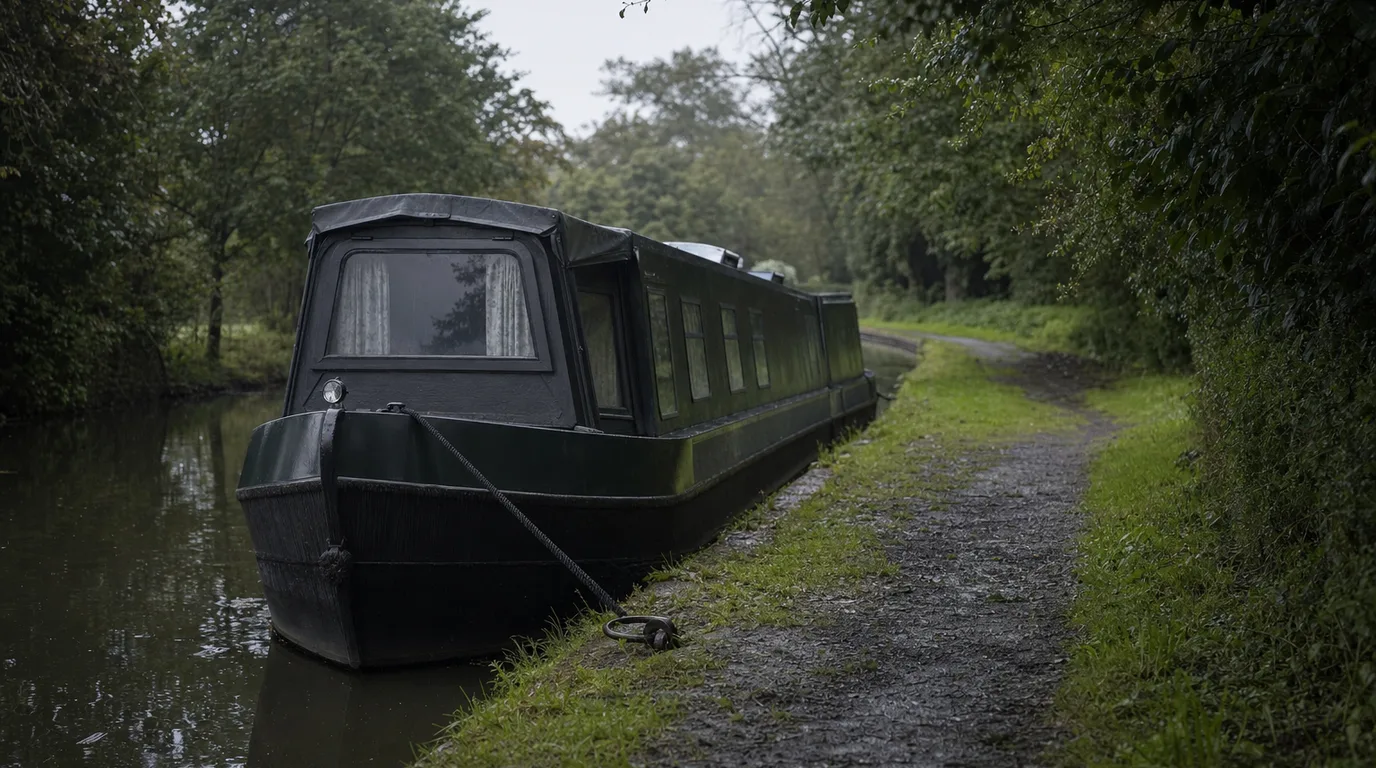
A narrowboat interior works when it treats the 6'10" width as a design rule, not a problem. Light colours above, richer tones below. Storage built into every run of furniture. Warm LED lighting on 12V. Natural materials (wood, brass, wool) that age well with the boat. And one or two things on the wall that are genuinely yours.
What makes narrowboat interior design different
You're designing for a space that's 6'10" wide and somewhere between 30 and 70 feet long. That's narrower than most hallways and longer than most living rooms, which means every decision compounds. The wrong sofa doesn't just look wrong; it makes the whole boat feel wrong. The right one, correctly placed, can make the saloon feel genuinely generous.
Three things shape narrowboat interior design that don't apply on land. First, everything is structural: walls hide wiring, gas runs, water pipes, and ballast channels. You can't move most of it. Second, the boat moves, subtly, always: materials need to flex rather than crack, and nothing can be fitted so tightly it can't expand in a damp winter. Third, you're living at 12V for most of your electrical needs, which changes every choice about lighting and appliances.
None of this makes a beautiful interior impossible. It makes it more considered. That's not a bad thing.
Choose a narrowboat layout
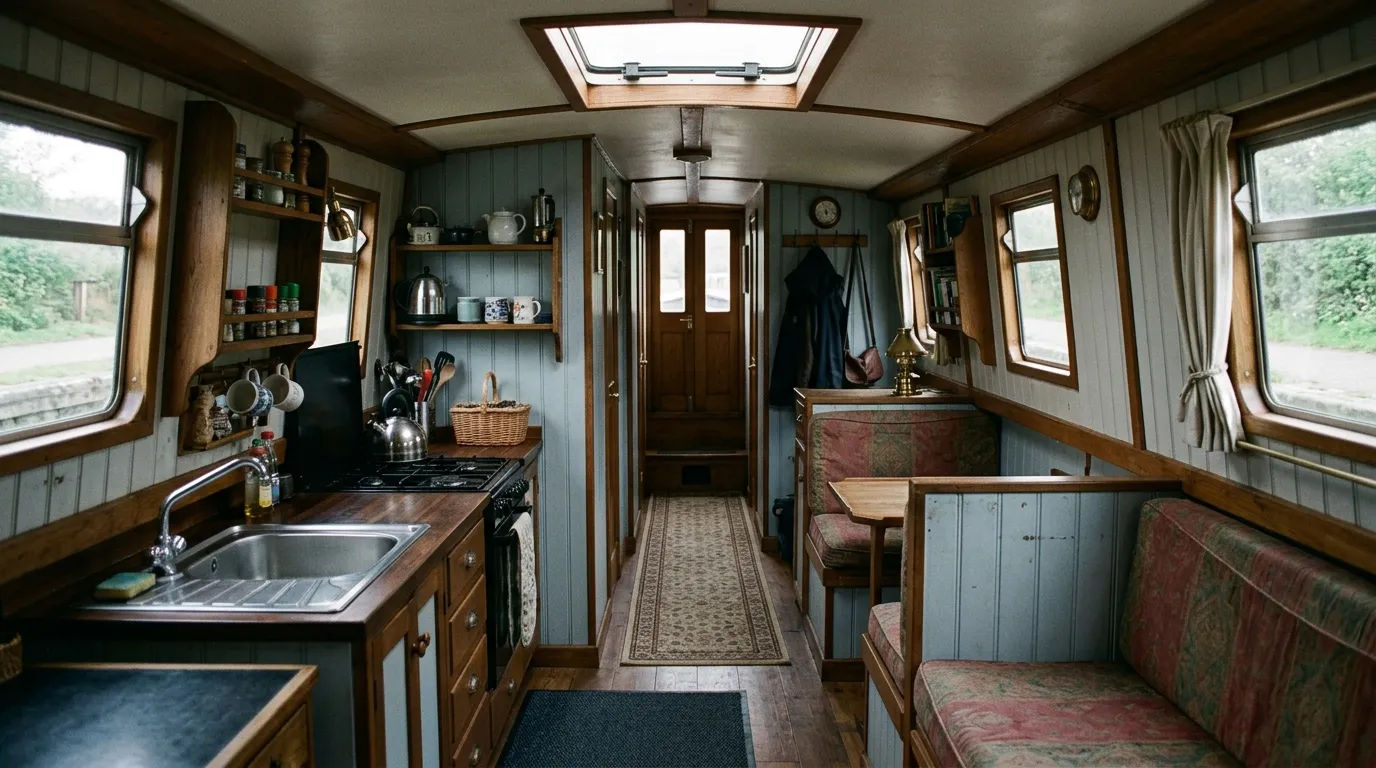
Before colour or storage, the layout decides what the inside of a narrowboat can be. Two choices drive it: what happens at the stern, and which end you put the living space.
Traditional stern. A small rear deck with standing room for the steerer and not much else. The engine sits under the deck plates and the cabin runs almost the full length of the boat, so a trad gives you the most interior for a given hull. The trade is company: whoever is steering is on their own back there, and in rain everyone else is below.
Semi-traditional stern. The rear deck is enclosed by high steel sides, so from the towpath it reads like a trad, but there is room for someone to sit with the steerer. It is the compromise most people end up describing as the sensible one, and it costs a little cabin length against a trad.
Cruiser stern. A large open deck at the back, room for several people, a table, a dog. It is the sociable option and the obvious one for summer cruising, and it takes the most length out of the cabin. If you plan to live aboard through a winter, think about how much of the year that deck is genuinely usable.
Reverse layout. Rather than the usual run of saloon at the bow through to the cabin aft, a reverse layout puts the galley and saloon at the stern. The point is sociability: the person steering is next to the kitchen and the people in it, instead of separated from them by the length of the boat. It suits cruiser and semi-trad sterns particularly well, and it is worth considering before you commit to a fit-out, because moving a galley later is not a weekend job.
None of these is the correct answer. They are answers to different questions: how much time you spend moving, how many people are usually aboard, and whether the boat is a home or a holiday. Settle that first, because every decision below, from where the light goes to where the stove sits, follows from it.
How do you make a narrowboat feel bigger?
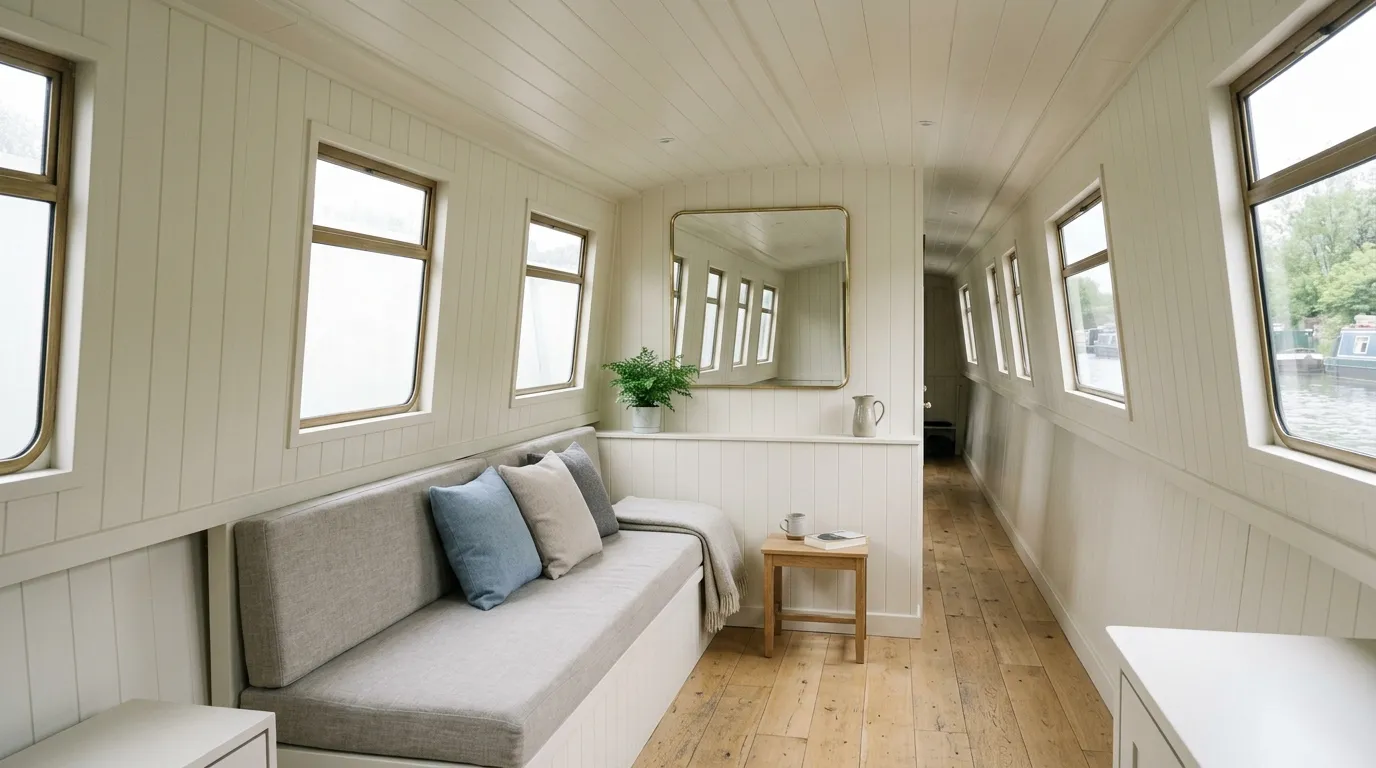
Light does most of the work. Pale ceilings and upper panels bounce what daylight there is around the space. A mirror on the wall opposite a porthole doubles the apparent width of the room at that point: a simple trick, and it works every time. LED strip along the roof-line cabinetry (under rather than above it) creates a floating effect that lifts the ceiling visually.
Furniture continuity matters more than you'd think. Four separate chairs read as four separate objects crowding the space; a single upholstered bench with four cushions reads as one deliberate thing. Where you can run storage, seating, and sleeping as one continuous element along a wall, do it. The eye follows the line all the way to the stern hatch and the space reads longer, not narrower.
On a boat this narrow every object is either working for the space or working against it. There is no neutral ground, which is why the question to ask of anything you bring aboard is what it displaces rather than whether you like it.
Fewer, larger objects beat many small ones. Three carefully chosen items on a shelf look considered. Twelve small items look like a charity shop. This rule applies everywhere on a boat, but it's especially unforgiving in a saloon where you can see the whole room at once.
What colours suit a narrowboat interior?
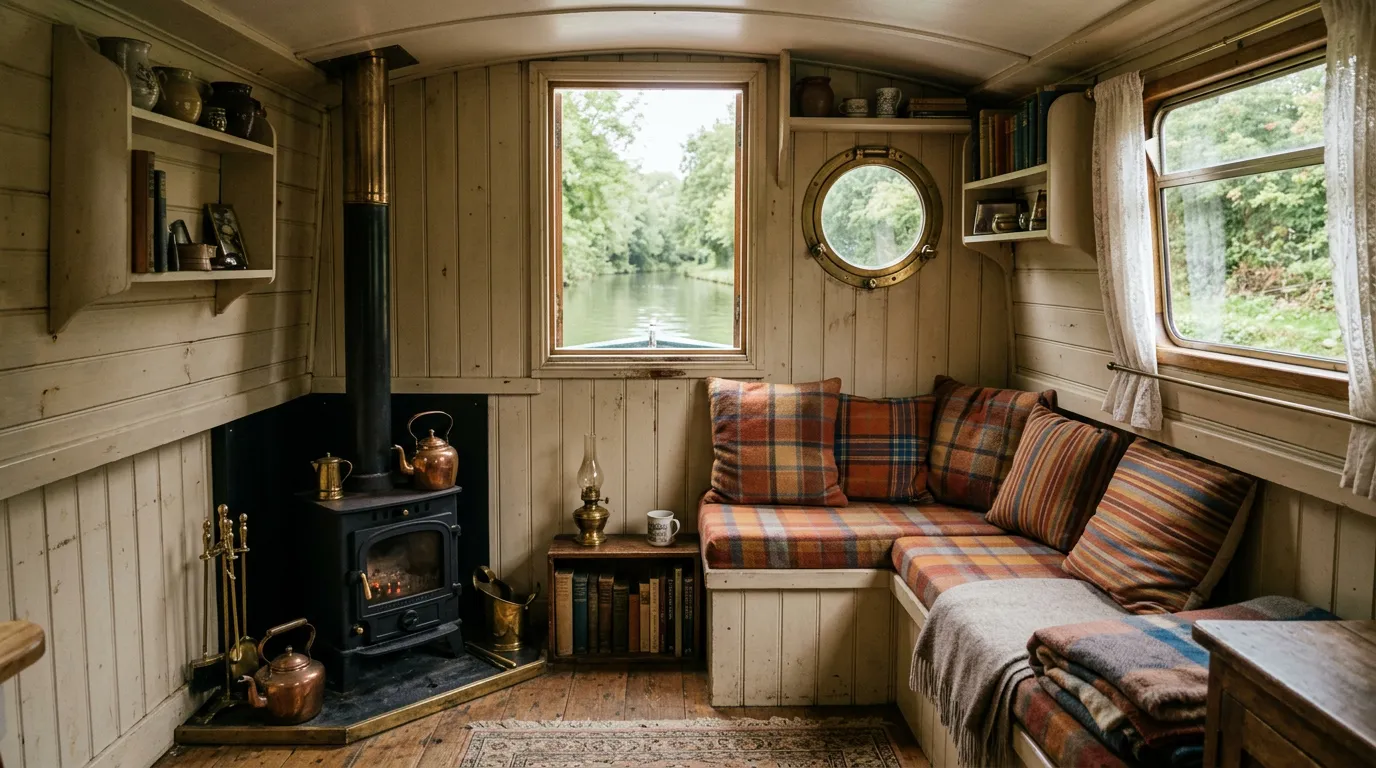
The traditional canal-craft palette is more practical than it might seem: cream and ivory ceilings, bottle green or deep teal on the lower panels and cabinetry, brass and bronze for hardware. It's the palette because it works: the warm neutrals above keep the space airy, the richer tones below anchor the room and ground the eye without pressing the walls inward.
If you want to push it somewhere more contemporary, forest green with natural oak trim reads well, as does terracotta with cream panelling. Oxblood or deep burgundy on a feature wall (the bulkhead behind the stove, say) gives a period railway-carriage quality that suits the proportions. What doesn't work, almost universally, is cool grey: it reads as cold in English light and clinically blank in a small space.
Avoid the impulse to paint everything the same shade to make it 'flow'. Tonal contrast between ceiling, walls, and cabinetry is what gives a small interior depth. Without it you get a tunnel.
- Ceiling and upper panels: warm white, ivory, oatmeal, pale stone
- Lower panelling and cabinetry: bottle green, deep teal, forest green, terracotta, oxblood
- Woodwork and trim: natural oak, ash, or painted in cream or heritage off-white
- Hardware: unlacquered brass or bronze: it ages correctly with the material palette
- Soft furnishings: warm wools, aged leather, linen: nothing cold or synthetic-looking
Storage, furniture, and multi-functional everything
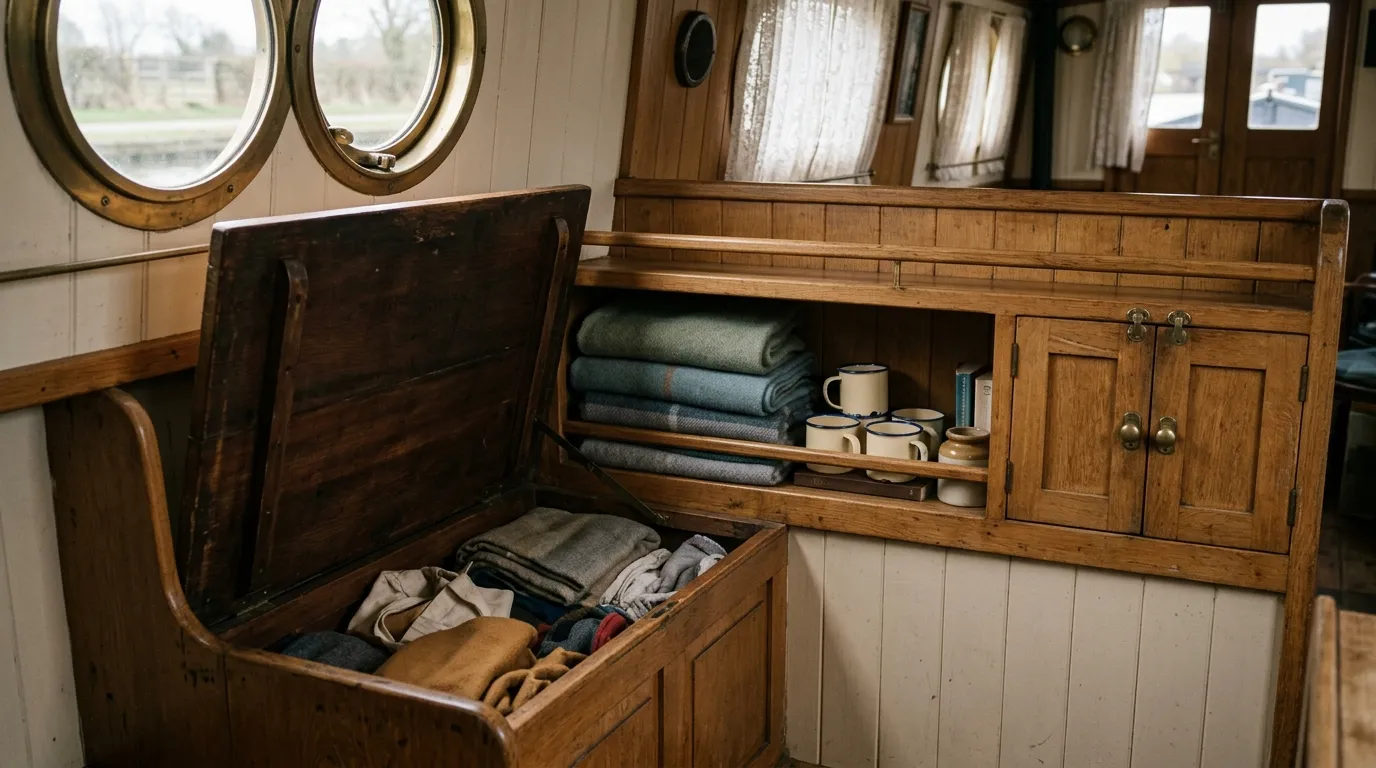
Storage on a narrowboat is a design discipline, not an afterthought. Every run of seating should have a hinged lid or drawers beneath it. The space above the gunwales (the curved section where the hull meets the roof) is often wasted: a line of shallow drawers there, built to the curve, can hold a surprising amount without taking up floor space. Steps up into the cratch or down into the engine room are another common lost cavity; build them as drawers.
Furniture that does two things is almost always preferable to furniture that does one. A dining table that folds against the wall when not in use. A bed that converts to a sofa with the right cushion arrangement. A bench seat with a backrest that hinges forward to reveal the wardrobe behind it. None of this is new thinking (narrowboat fitters have been doing it for decades) but it's worth saying clearly: if a piece of furniture does only one thing, it's probably not earning its place.
Fixed cabinetry that runs floor to ceiling on at least one wall also gives the room a sense of order that freestanding furniture rarely achieves. It reads as built, not arranged: which is the quality all good small-space interiors have.
Materials: wood, brass, and why they work
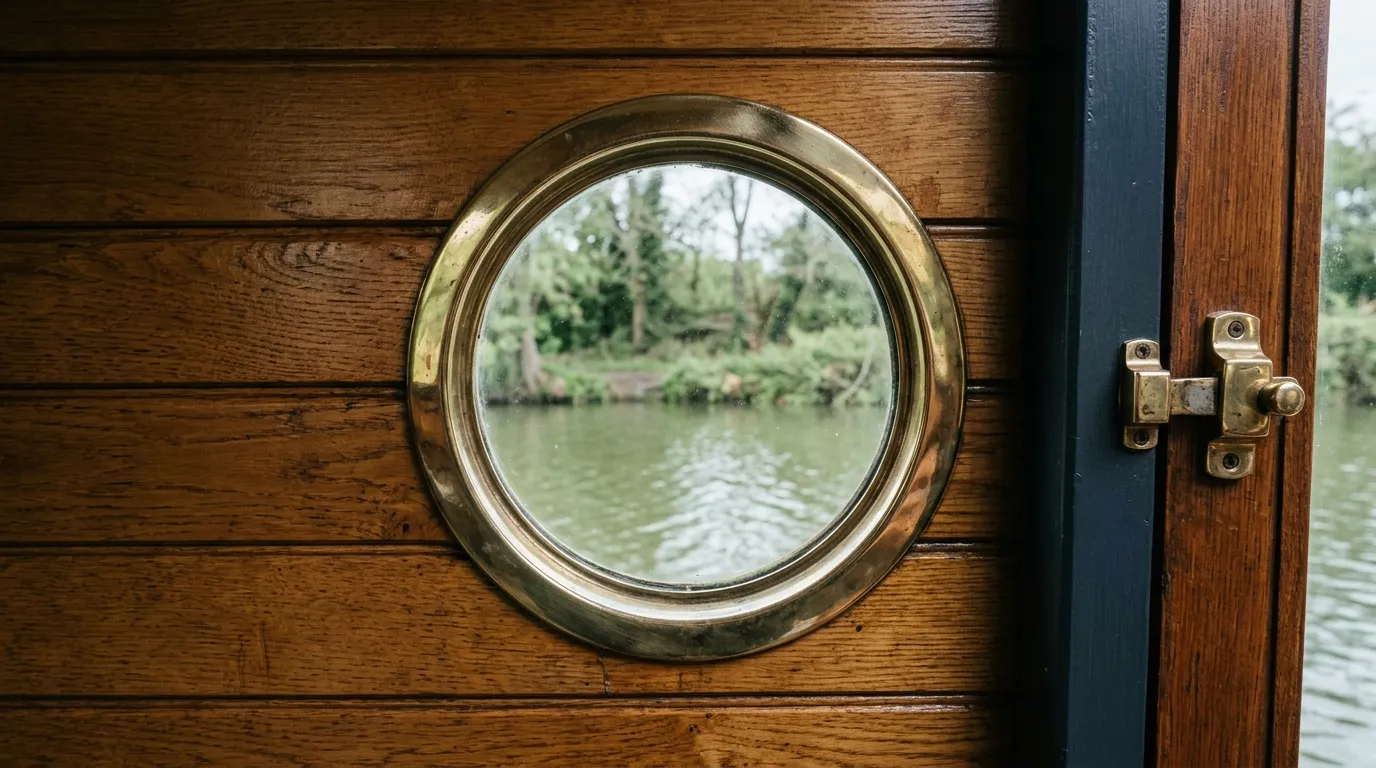
Natural materials age well on a boat. Wood expands and contracts with moisture but it does so slowly, predictably, and repairably. Hardwood-veneered plywood is the standard for cabinetry: oak and ash are both common, both good. Solid hardwood for exposed trim and door frames. Painted softwood where you want a traditional canal-craft feel and don't mind repainting every few years.
Brass is the right hardware choice on a narrowboat. Not because it's traditional, though it is: it's because unlacquered brass develops a patina that's warm and lived-in rather than degraded. Chrome, by contrast, scratches easily in a working environment and looks worse over time rather than better. Brushed bronze or antique brass are the contemporary equivalents and work equally well.
Avoid MDF for anything structural or anything exposed to moisture. It swells, it doesn't recover, and it's almost impossible to repair. Marine plywood for anything that might get wet. Solid timber where you want the grain to show.
The Canal & River Trust's boating guidance covers the structural requirements that affect interior fitting, useful reading before starting a fit-out if you're not using a specialist narrowboat builder.
Lighting on a narrowboat: the 12V reality
Your lighting runs at 12V DC from the battery bank unless you're running an inverter. LEDs are the only sensible choice: they draw almost nothing, generate almost no heat, and the quality of warm-white 12V LED products available now is genuinely good. Buy fittings designed for 12V rather than adapting 240V ones; the voltage drop across long runs matters and purpose-built 12V fittings account for it.
Layered lighting is the difference between a boat that feels cosy and one that feels like a caravan. A warm ambient strip along the roof-line for general light. Individual reading spots recessed into the cabinetry above the bench seats. A dedicated task light over the galley. A softer, warmer lamp setting for evenings: a 12V brass globe or a converted oil lamp on a dimmer. Each layer does a different job. All four running together, dimmable, give you a lighting scheme that a lot of on-land living rooms don't have.
Portholes are fixed features and they don't give you much to work with in terms of natural light. Position your seating and reading areas close to them during the day, and accept that a well-lit evening interior is largely an artificial-light project. This is normal on a boat, and it's not a problem: it's an opportunity to be deliberately warm.
The stove: heating, aesthetics, and the whole room
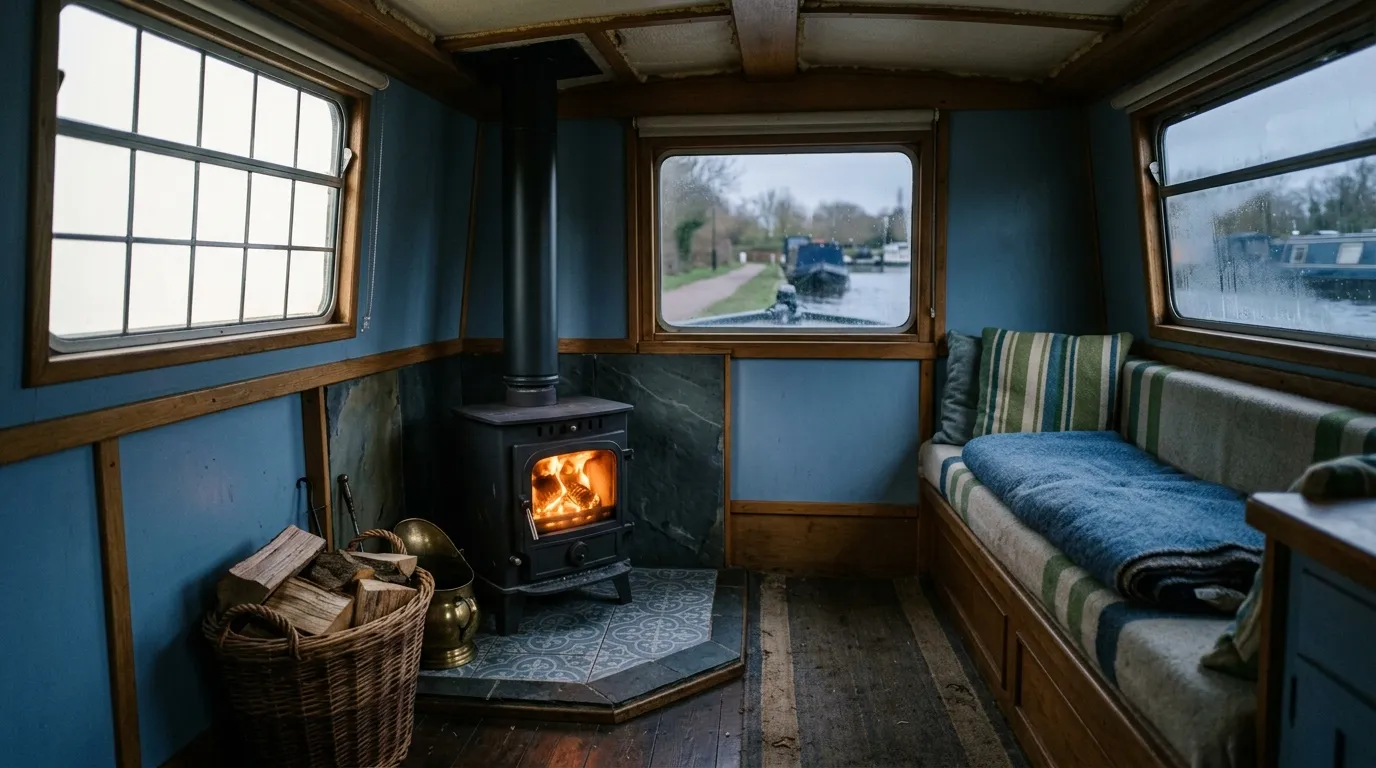
A solid-fuel stove is the heart of most narrowboat saloons: not just as a heat source, but as a focal point that organises the room. Everything in a well-designed saloon gestures towards the stove: the seating faces it, the floor rug defines the zone in front of it, the brass log basket sits beside it. Remove the stove and you have a corridor. Keep it and you have a room.
Cast iron is the standard material and for good reason: it radiates heat long after the fire has died down, which matters overnight in winter. The flue passes through the cabin roof so the combustion gases leave above the roofline, and how it is installed is one of the things a Boat Safety Scheme examination looks at rather than a matter of taste. The collar where it exits is worth getting right aesthetically; a plain stainless collar looks fine, a decorative brass collar looks better.
If you're buying a stove for a narrowboat, check the BSS (Boat Safety Scheme) requirements before purchasing: the inspection covers flue installation and clearances, and non-compliance means a failed certificate. The Boat Safety Scheme publishes the full technical standards online.
Soft furnishings, textiles, and the human layer
Textiles are the fastest way to change a boat interior. A wool runner on the floor, a set of decent cushions on the bench seat, curtains at the portholes: they do more per pound than almost any structural intervention. They're also the easiest thing to replace if you get them wrong.
Wool and heavy linen both handle boat humidity better than synthetics, which can feel clammy and hold moisture in the weave. A wool rug with a felt underlay also deadens the hollow resonance that timber floors can have in a long, thin space. Velvet cushions look well in photographs but flatten quickly with daily use; a tighter weave or a woven or jacquard fabric lasts better.
Porthole curtains are worth thinking about carefully. They're the thing you'll see and touch most often. A linen or cotton-linen blend in a warm neutral, with a simple eyelet or tab heading, ages well and doesn't collect dust the way a heavier fabric does.
Personal touches and wall art on a narrowboat
A narrowboat interior can be beautifully considered in every material choice and still feel like a show home rather than somewhere someone lives. The things that make it yours are usually small and specific: a framed photograph from the first trip, a name plate salvaged from a previous boat, something on the wall that needs a story to explain it.
Wall art works well on timber-panelled walls; the warm background suits print colours in a way that white plaster doesn't always. A framed A3 print reads well without dominating the space: smaller than you might put on a house wall, but that's correct in proportion. A grouping of two or three prints at the same height, evenly spaced on the long cabin wall, gives that wall something to do without crowding it.
If you want a picture connected to the boat, a name print is one option. Compare the personalised narrowboat prints with the name canvas, then check the available dimensions and current price against your wall space. Both are decorative interior pieces: they are not licence, registration or safety signs.
If you're not sure where to start with narrowboat gifts and personalised pieces, that page covers everything we make and when each works best.
Where to go next
If you're thinking about narrowboat life more broadly: moorings, licences, costs, and the differences between liveaboards and weekenders, our narrowboat life guide covers the practical side. And if you're choosing a name for the boat you're about to fit out, our narrowboat names guide walks through the seven traditions, the C&RT register, and the rules nobody tells you.
Fitting out is what happens once you are living aboard and the boat has stopped being a purchase. Settle the toilet question first, because it decides one whole end of the layout before any of the finishes do. How canal locks work is the other thing a new owner reads before the paint is dry.
Written by Craig Fearn, Narrowboat Gifts. Last updated .