In short. Push the tiller the opposite way to where you want the bow to go, steer from the stern rather than the front, and go slower than feels natural. A narrowboat pivots around a point roughly a third back from the bow, so the back end swings out — which is the single thing beginners don't expect.
Basic boat handling
These first four points cover the basic controls, and they explain why a narrowboat feels so different from a car.
The tiller works backwards
Push the tiller to the left and the bow goes right. It is the opposite of a steering wheel and it takes about an hour to stop thinking about it. Small movements: a narrowboat responds slowly and then keeps responding, so a big correction becomes a bigger one in the other direction.
Steer from the back, not the front
On a car the front wheels lead. On a narrowboat the stern swings. When you turn, the bow goes where you point it and the back end swings the other way. That is how beginners hit moored boats they thought they had cleared. It is also how the stern catches a lock wall on the way out.
Watch the stern as much as the bow, especially in locks, bridge holes and when leaving a mooring.
Slow is control
Steering needs water flowing past the rudder, so you need some way on. But the limit is 4mph on canals and 6mph on most rivers, and the real test is your wash. If the water behind you is breaking, or a moored boat is rocking as you pass, you are going too fast. Ease off. Nobody has ever been late on a canal.
Drop to tickover roughly two boat lengths before passing moored boats, not as you draw level. It is both courtesy and self-interest: wash pushes water off the shallow shelf at the edges and can ground the boat you are passing.
Stopping and reverse
There are no brakes. There are no brakes. You stop by putting the engine astern, and a narrowboat in reverse does not steer at all — the stern walks to one side depending on which way the propeller turns, so you go where it decides rather than where you point it. Plan stops early. Use reverse to slow, never to manoeuvre.
Coming alongside, aim to arrive at walking pace with the boat almost parallel, then use a short burst astern to stop. A rope round a bollard is not a brake and will not act like one.
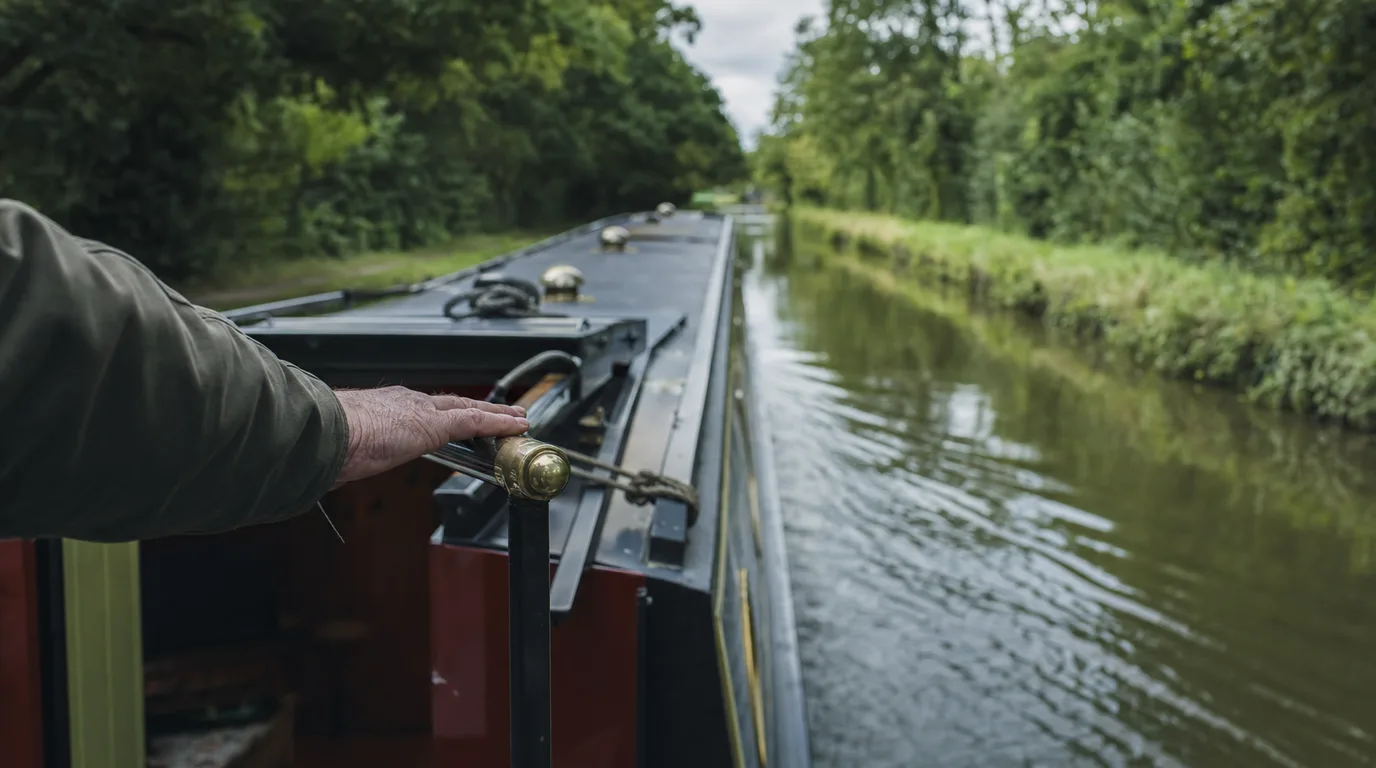
Wind, mooring and sharing space
Conditions outside the boat make steering harder, so this section covers wind, mooring and sharing space with other boats.
Wind is the real difficulty
A narrowboat is a long flat surface with very little underwater. In a crosswind it behaves like a sail, and at low speed the wind wins. The counter-intuitive answer is usually a little more speed for steerage, and accepting you will approach a mooring crabwise.
Coming alongside and mooring up
Approach at about twenty degrees, at walking pace, and straighten at the last moment so the boat arrives parallel and barely moving. Slower is better. You can always give it another nudge. A short burst astern stops you. Step off — do not jump — with the centre line in hand, and get that on first: one rope amidships holds the boat while you sort bow and stern.
Where the bank is soft you use mooring pins driven in at an angle away from the boat; on a piled or ringed bank you use the rings. Leave a little slack. Do not pull the boat tight to the edge: the canal is shallowest there, and a boat hauled hard against a shelving bank sits on it when the level drops.
Sharing a lock, and tunnel manners
On a wide canal two narrowboats share a lock, which halves the water used and the work. Enter side by side, keep the boats apart with a hand rather than a foot, and agree who works which gate. On narrow canals you go through one at a time and turn the lock for whoever is waiting.
In tunnels: headlight on, keep to the right where two-way passage is allowed, and do not stop. Sound your horn on entry where the tunnel is blind. The Trust's Boaters' Handbook sets out the conventions properly, and they are conventions worth knowing before you meet a boat coming the other way in the dark.
Learning to steer
Most worries come down to a few awkward moments, and the learning route is simpler than many people expect.
The bits people find hardest
- Bridge holes. Line up early and go straight through; there is no room to correct halfway.
- Entering a lock. Slow, straight, and watch the stern swing as you turn in.
- Turning around. Only at a winding hole wide enough for your length. Reversing a long way is unpleasant and rarely necessary if you plan.
- Single-handing. Everything above, plus getting off to work locks. A long centre line is the tool that makes it possible.
For the full official version, the Trust's Boaters' Handbook is the standard reference and covers handling, locks and safety in one place.
Nobody needs a licence to learn
No qualification or test is required to steer a narrowboat on the canals. Hire bases give a handover briefing and send you off; most people are competent within a day and confident within a week. The learning curve is short, which is why so many first-time hirers end up owning one.
And when they do, the first decision is what she is called.
Where to go next
- How canal locks work — the other half of the skill.
- What to take on a canal boat holiday — the practical list before you set off.
- Choosing a narrowboat name — for when the hire week gives you ideas.