In short. Most UK canals are dredged to between about three and four and a half feet in the main channel. But the middle isn't the number that matters. The Canal & River Trust's own warning is the important part: maximum depth does not extend for the full width. The edges are shallower, and silt makes them shallower still. Steer for the middle.
How deep is a canal? It depends where you are across the cut
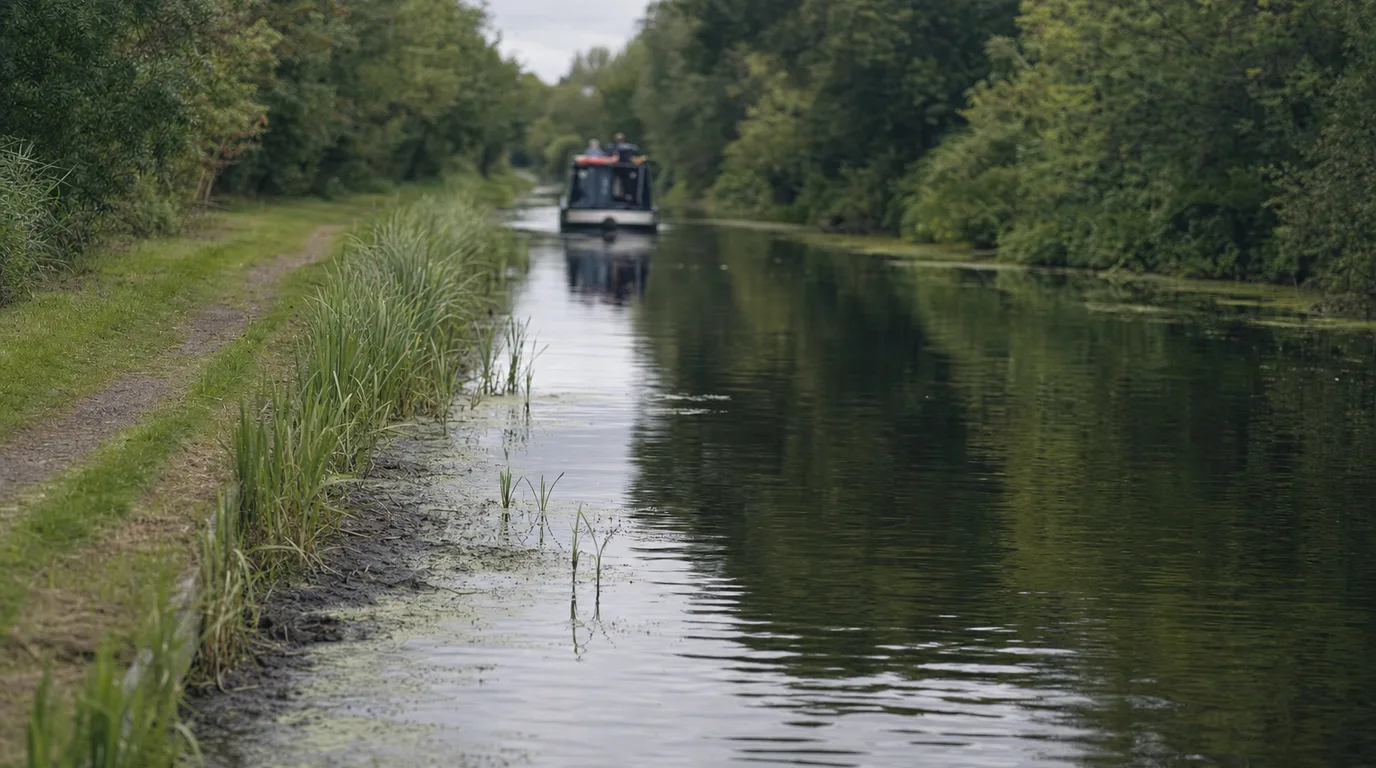
A canal is not a bath. It is dredged deepest along the navigation channel — roughly the middle — and shelves up towards each bank. That is why boats pass one another in the centre and why mooring against an untended bank often means sitting on the bottom.
The Trust publishes a maximum draught for each waterway rather than a depth, because draught is what constrains you. On the Grand Union main line the figure is 1.3m, about 4ft 3in; on the Leeds & Liverpool it is 1.22m, about 4ft. A boat drawing less than that will float in the channel. It may still ground three feet from the towpath.
Depth, draught and grounding
Depth on the cut is more complicated than a single number, because several measurements decide whether a boat floats freely.
Why boats run aground when the canal is "deep enough"
- Silt. Canals fill in continuously — mud, leaf litter, whatever washes off the banks. Dredging is maintenance, not a one-off, and stretches waiting their turn are shallower than the published figure.
- The shelf at the edge. Most groundings happen while mooring or pulling over, not in mid-channel.
- Hull shape. The Trust notes that widebeam and flat-hulled boats are more likely to ground outside the main channel than a narrowboat of the same draught.
- Water level. Pounds draw down in dry summers and after heavy lock use, and a few inches matters.
Worth knowing before it happens: you are responsible for removing your own boat from the waterway and for any damage caused, so grounding is your problem rather than the navigation authority's.
Depth is only one of four dimensions
Route planning uses four numbers, and any of them can stop you:
- Draught — how deep your hull sits. The depth question, from the boat's point of view.
- Air draught (headroom) — bridges and tunnels. On both the Grand Union main line and the Leeds & Liverpool the Trust gives 2.67m, about 8ft 9in. Chimneys and roof boxes come off before low bridges.
- Beam — 2.13m / 7ft on the narrow canals, which is why narrowboats are built to 6ft 10in. Wide canals take 14ft and more.
- Length — 21.95m / 72ft on most narrow canals; the Leeds & Liverpool is shorter at 19.51m / 64ft.
Those last two are why a boat that fits everywhere is a narrowboat under 60ft. Longer or wider, and parts of the network close to you. The full table is on the Trust's waterway dimensions page and is worth checking before buying, not after.
Why a canal holds water at all
A canal is a man-made channel lined to stop water draining away. Historically that lining was puddled clay — clay worked with water and trodden until it formed a watertight skin, laid by hand along the whole length. Later and repaired sections use concrete or a synthetic membrane. It is why a breach is such a serious event: once the lining is punctured the water leaves quickly and takes the embankment with it.
Holding the water in is only half of it; the other half is putting it back. A canal is fed from reservoirs at its summits, and every lock worked sends a chamber of water downhill, so the network loses from the top continuously and is topped up continuously. That is why a dry summer shows up as restrictions rather than as a lower canal — lock closures, and locks worked in pairs so two boats spend the water one would have.
That lining is also why depth is finite and maintained rather than natural. Dredging removes what settles on top of it. It is a rolling programme rather than a one-off, and because the network runs to thousands of miles while the maintenance budget does not stretch to all of it at once, a stretch dredged this year may not be touched again for a decade. Most of that work happens in winter. Pounds are drained, gates are replaced, and the silt comes out.
Clearances and what they mean
Height and width limit a boat as much as depth does, and a few surprises tend to catch new boaters out.
Tunnels, bridges and the vertical squeeze
Depth has a mirror image above the waterline. Tunnels are the tightest constraint on the network. Some are wide enough for two boats to pass. Others take one at a time, worked by timed entry or plain courtesy. Headroom inside is lower than the open canal, and because the roofline of a boat is rarely measured as carefully as its draught, a tunnel is where chimneys, aerials and flowerpots get knocked off. Measure once. It saves the chimney.
So know your air draught as precisely as your draught. Measure to the top of anything fixed on the roof. Take down whatever is not. Both figures appear per waterway on the Trust's dimensions table.
What it means in practice
- Pass other boats in the middle, and slow right down — wash pushes water off the shelf and can ground a moored boat.
- Moor where others moor. An empty stretch of bank is often empty because it is shallow.
- If you touch bottom, do not power out of it hard. That drives you further on and stirs silt into the engine intake.
- Check draught before committing to an unfamiliar arm or a shallow branch.
The bit that surprises people
Canals are shallower than almost everyone guesses. Four feet of water is chest deep — the reason towpath safety advice is about cold and mud rather than depth. Working boats were built to that constraint, which is why a narrowboat draws so little and carries its weight along its length rather than down.
It is also why a boat is such a specific object. Built to a canal's dimensions, named by its owner, and worked along the same few waterways for years.
Where to go next
- How canal locks work — how the water gets from one level to the next.
- Narrowboat, canal boat or barge? — which word is right, and why the beam decides it.
- Buying a narrowboat — where length and draught affect what you can buy.
- English canal maps: which map to use, and the boat sizes the Trust publishes.