In short. Retiring onto a narrowboat works well for people who want the life and badly for people who want the saving. The practical questions are mooring, winter, healthcare access and what happens when climbing lock beams gets harder — and those are answerable before you commit, not after.
Why living on a narrowboat in retirement is the moment people do it
Two constraints disappear at once. You no longer need to be near a workplace, which removes the reason most people pay city mooring prices or stay in one spot. And you gain the time the life demands — filling water, moving every fortnight if you cruise continuously, working locks, doing maintenance in weather. Boating rewards having time in a way that a working week rarely allows.
It is also a moment when a house is often sold, which is where the money question comes in.
Money, mooring and the rules
The financial and legal basics decide whether retirement afloat works, so they come before the daily detail.
The money, honestly
Selling a house and buying a boat outright leaves capital and removes rent or a mortgage. That is real. What it does not remove is the annual cost of keeping a boat, which continues whether you cruise or not: licence, insurance, Boat Safety Scheme certificate, blacking, heating, and a mooring unless you continuously cruise.
Price your own rather than borrowing an average — the Trust's licence calculator prices your exact length, and we have broken down what is knowable and what is not in the cost of living on a narrowboat.
The trap is treating the boat as an investment. It's a depreciating object you maintain, not a house that grows. People who retire afloat because they want the life are content; people who did it purely as an arithmetic exercise tend to resent the blacking bill.
Mooring, and the decision that shapes everything
- Residential mooring. A fixed address, post, utilities, often parking, and neighbours. The expensive option, and scarce — secure one before selling a house, not after.
- Continuous cruising. No mooring fee, and a genuine legal obligation to keep moving on a progressive journey. Freedom, and a fortnightly commitment in all weather, indefinitely.
- Leisure mooring. Cheaper, but usually does not permit living aboard full time. Check the terms rather than assume.
For most retirees the honest question is whether they will still want to move the boat every fourteen days in ten years' time. If the answer is uncertain, that argues for a residential mooring even at the cost.
What continuous cruising legally requires
This is the part most often misunderstood, and it matters more in retirement than at any other stage — because the obligation does not soften with age.
The requirement comes from the British Waterways Act 1995: a boat without a home mooring must be used for bona fide navigation — a legal term meaning cruising a fair range of the network, rather than shuffling between two spots. The Canal & River Trust sets out what that means in practice in its continuous cruising guidance.
- Fourteen days is the maximum in one place on most of the network, and less where signs say so.
- "Place" means a neighbourhood, not a mooring spot. Moving fifty yards up the same stretch does not restart the clock.
- The journey must progress. If you were in neighbourhood A a fortnight ago, by day fifteen you should be in B — and the move after that to C, not back to A.
- The burden of proof sits with you. The Trust's own guidance is explicit that it is for the boater to satisfy the Trust the requirement is met, not for the Trust to prove it has not been. Licences have been refused on this.
Read plainly: continuous cruising is a commitment to keep moving every fortnight, in February as well as July, for as long as you hold that licence. Plenty of retired boaters love exactly that. The ones who struggle are those who chose it to avoid a mooring fee and discovered they had bought an obligation instead.
Living afloat through the year
A year on the water has its own rhythm, and these sections cover the seasons, the safety net and the checks.
The shape of a year afloat
Retirement afloat has a rhythm that a working life rarely allows you to notice:
- Spring. The network reopens after winter stoppages, the towpath dries out, and everyone reappears. The best cruising months are April to June, before the school holidays fill the popular flights.
- Summer. Busy, sociable, and slower going — queues at locks, moorings taken by mid-afternoon near anywhere with a pub. Start early.
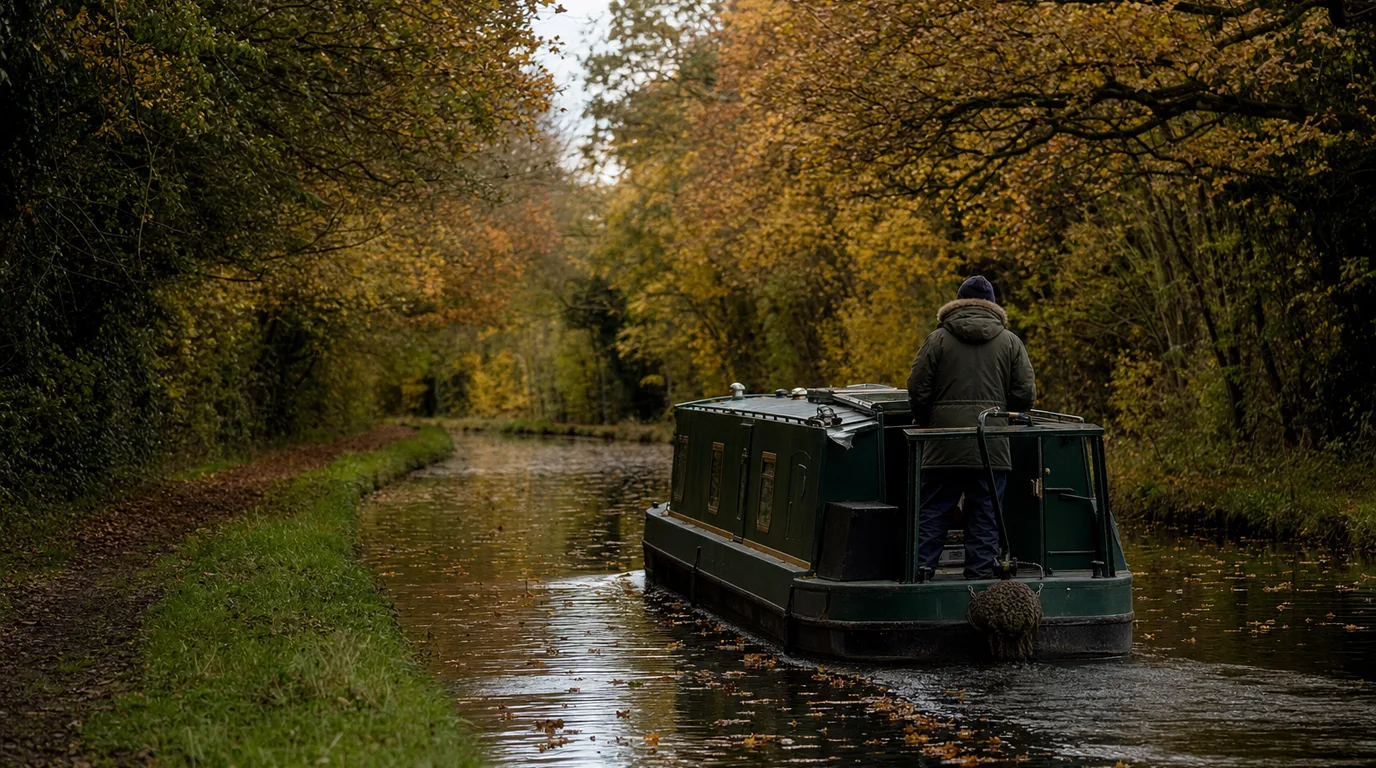
- Autumn. Many boaters' favourite: quiet water, colour on the banks, and the last comfortable cruising before the clocks change.
- Winter. Stoppages close sections for gate replacement and dredging, so routes need planning around published closures. Days are short, the stove is lit by four, and a lot of the time is spent aboard.
Continuous cruisers plan the winter deliberately — often a winter mooring, which the Trust sells seasonally, so the fortnightly obligation pauses through the worst of it.
Having an exit, and why it makes the years better
The best-prepared people afloat have thought about how it ends before it starts. Not morbidly — practically. A boat is a saleable asset, but it sells slowly and rarely at the moment you need it to, and the sale takes a survey and a buyer as the purchase did.
The usual routes out are: move to a residential mooring and stop cruising, sell and rent ashore, or hand the boat on within the family. Each is easier if the boat has been maintained on schedule — blacking every two to three years, a current Boat Safety Scheme certificate, and paperwork kept together. A well-kept boat sells; a neglected one becomes somebody's project at a project price.
People who have thought this through enjoy the cruising more, not less, because the decision is already made rather than hanging over them.
Winter is the test
Anyone can enjoy a boat in July. February is the qualification: condensation on steel, carrying coal, ash to empty, short days, a stove to light before the cabin warms. Boats with good insulation and a reliable heating system are a different proposition from boats without, and it is worth viewing in bad weather rather than sunshine.
It is also worth being blunt about mobility. Lock beams are heavy, towpaths are muddy and uneven, and stepping on and off a boat in the dark is a real thing. Plenty of people boat into their eighties; plenty of others move to a residential mooring when the cruising gets hard. Both are fine, and planning for the second makes the first more enjoyable.
Practicalities people forget to check
- Post and admin. Without a fixed address you need a forwarding arrangement — a marina office, family, or a service. Banks, insurers and the NHS all want an address.
- GP registration. Straightforward with a residential mooring, more complicated while continuously cruising. Sort it before you need it.
- Pension and deliveries. Both work fine, but both assume you are somewhere consistent.
- Car. If you cruise, the car is either sold or permanently in the wrong place.
- Visitors and grandchildren. A boat sleeps fewer people than a house, and the ones it sleeps are close together.
Choosing the boat and downsizing
The boat itself matters more in retirement than on a holiday, and space is the main thing to plan around.
Choosing the boat for a retirement, not a holiday
The boat that suits a fortnight afloat is not always the boat to retire onto. Things that matter more when it is home:
- Length against handling. More length is more living space and more boat to work, moor and turn. Many people retiring afloat settle between 55ft and 60ft — enough for a fixed bed and a separate seating area, still able to use most of the network. Above about 62ft, parts of the system start closing to you.
- A fixed double bed, not a convertible one. Making up a bed nightly is fine for a week and wearing for a decade.
- Insulation and heating. The single biggest determinant of whether winter is pleasant. Ask what the insulation is and how old the heating system is, and view in cold weather if you can.
- Step heights and handholds. Getting in and out of the engine bay, up the steps to the stern, and on and off at a low mooring. Worth thinking about now rather than at eighty.
- A stern you can work. A semi-trad or cruiser stern gives room for two people at the tiller; a traditional stern is a solitary spot in the rain.
Downsizing, and what fits
The hardest part of moving aboard from a house is not the boat — it is the possessions. A narrowboat has roughly the floor area of a large garden shed arranged as a corridor, and every object has to earn its place. People routinely underestimate this by an order of magnitude.
What survives the cut tends to be: a small number of books, the kitchen equipment used weekly, clothes for the weather rather than the wardrobe, and the photographs. What goes into storage usually stays in storage, and paying to store things you never retrieve is a common and quiet cost of the first year.
Community and preparing to start
The people around you and the preparation you do both shape how well retirement afloat works, so this last stretch covers them.
The community, which is the part nobody predicts
Retirees afloat consistently report the social side as the thing they undervalued beforehand. Moorings and marinas have a settled community; the towpath has a passing one. People help with locks, lend tools, and notice when a boat has not moved. For anyone worried about isolation in retirement, canal life is generally more sociable than a suburban street, not less.
The counterweight is that continuous cruising moves you away from that community every fortnight, which suits some people and unsettles others. It is a real difference between the two ways of living aboard, and worth weighing alongside the money.
Pets, visitors and the practical rest
- Dogs. Extremely common aboard and generally happy — endless walks along the towpath. Consider the step off the boat and whether an older dog will manage it.
- Cats. Workable, more so on a permanent mooring than while cruising.
- Grandchildren. A boat is a marvellous thing to visit and a small thing to sleep in. Most people manage two at a push and enjoy it enormously.
- Insurance in later life. Boat insurance does not have the age cliffs that some travel and motor policies do, but declare health conditions honestly and check what single-handed cruising means for cover.
- A land base. Some retirees keep a small flat or an arrangement with family. It removes several of the harder questions at a cost.
What to do before you commit
Hire for a fortnight, ideally including bad weather. Then hire again in a different season. The people who are happiest afloat almost all did this; the ones who sold up on the strength of one sunny week are over-represented among those who sell within two years.
Our guides on buying a narrowboat and life on a narrowboat cover the purchase and the rhythm of a year, and how canal locks work covers the daily skill.
The first thing new owners do
Choose the name. Whatever else retirement afloat involves, that part is straightforwardly enjoyable — and it is the detail that ends up on the wall rather than in a budget.
Where to go next
- The cost of living on a narrowboat — what is knowable and what is not.
- Buying a narrowboat — survey, licence and the purchase.
- Life on a narrowboat — the year, month by month.