In short. Four costs are fixed and knowable — licence, insurance, Boat Safety Scheme certificate and blacking. Retiring aboard changes the sums again, because the boat stops being a hobby and becomes the housing budget — living aboard in retirement covers that case. Two dominate the total and vary enormously — mooring and heating. Anyone quoting you a single annual figure is guessing at the second pair, because nothing authoritative is published about either.
The costs you can look up
The licence
Non-negotiable: you cannot legally keep a boat on the network without one, and the Trust will not re-licence a boat without a valid Boat Safety Scheme certificate. The fee follows the boat's length and width, and since 2024 there are surcharges for boats without a home mooring and for wide beams.
Rather than quote a number that dates, use the Trust's own licence price calculator — it prices your exact boat. For context on direction of travel, fees rose 4.85% from 1 April 2026, with those surcharges applied on top.
Boat Safety Scheme certificate
Required for the licence and renewed every four years. Budget for the examination plus whatever it finds — it checks gas, fuel, electrics and ventilation, and a fail means remedial work before you can licence.
Blacking
Steel boats come out of the water for blacking every two to three years, priced per foot. It is the single largest predictable maintenance item, and skipping it is how a sound hull becomes an overplating job.
Survey, if you are still buying
A one-off rather than an annual cost, and the Trust publishes what it should come to. The per-foot rates and the worked examples for a 55-footer are on buying a narrowboat, which is where that spend belongs - but it's the one number that decides how much of the rest of this list you will be paying in year one.
Fixed, irregular and hidden costs
Beyond the published figures, a narrowboat has a second layer of costs that varies by mooring, boat and how you live.
The costs nobody publishes
This is where honest guides stop and vague ones carry on. Nothing official exists for any of them, so treat any number you read — here or elsewhere — as somebody's estimate.
- Mooring. The biggest single variable in the whole budget. A residential mooring near a city and a rural leisure berth are different orders of money, and residential moorings are scarce enough that price follows availability. Continuous cruising removes the cost entirely, at the price of a genuine obligation to keep moving.
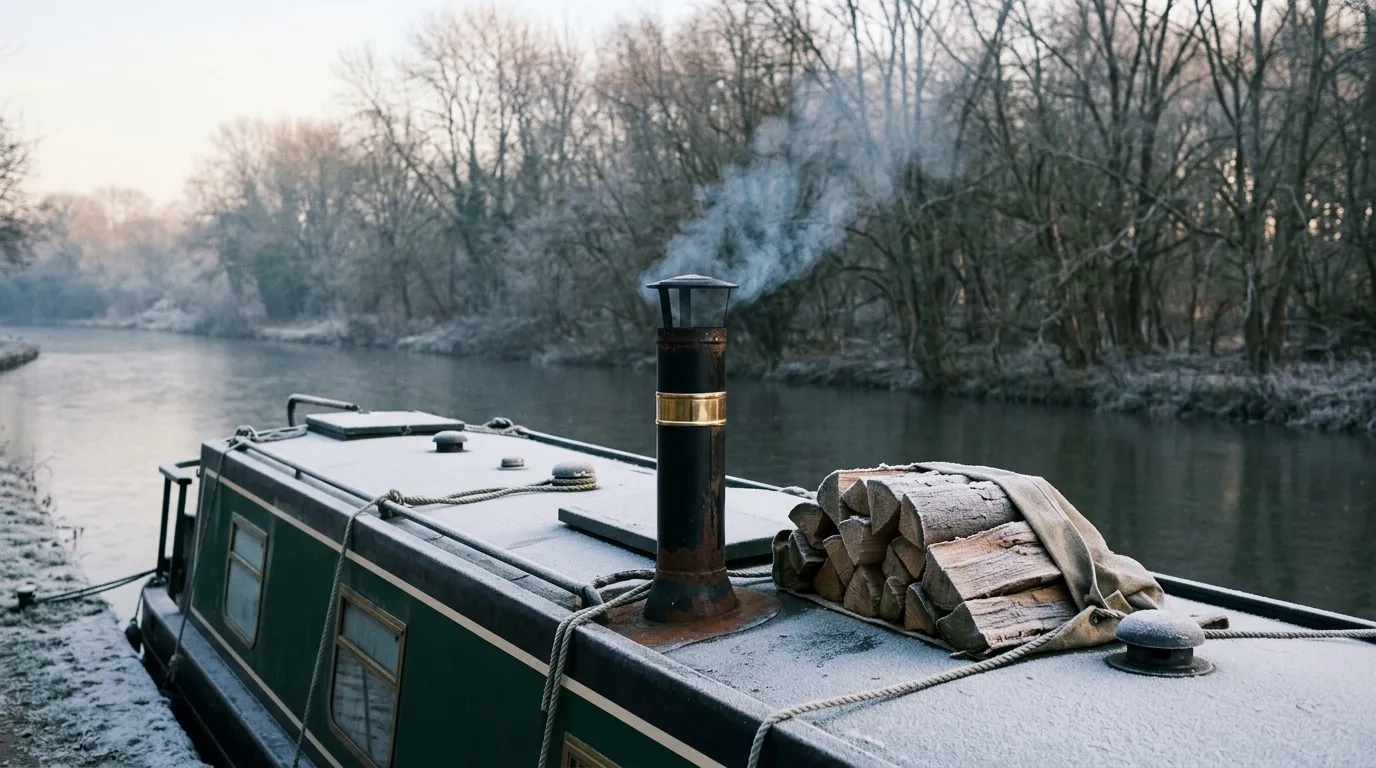
- Heating. Coal, wood or diesel, and it scales with the winter and how well the boat is insulated. A liveaboard through a cold February spends real money; a summer cruiser barely notices.
- Diesel for cruising. Proportional to how much you move. Continuous cruisers burn far more than a boat that sits on a mooring most of the year.
- Insurance. Modest relative to the rest, but requires that valid BSS certificate.
- Engine servicing and the unexpected. Something aboard is always slightly wrong. Owners who budget nothing for this are the ones who find it painful.
Mooring: what is published
Mooring is the largest and most variable cost, so it is worth knowing what the navigation authority does publish, since most guides assert a range.
The Canal & River Trust runs its own long-term moorings under the Waterside Mooring name — around 3,600 berths across more than 330 sites in England and Wales. Vacancies are searchable, and that is the honest way to price your own situation rather than trusting an average.
- Priced by length and demand. The Trust is explicit that moorings cost more in the south, where land values are highest, and that sites with better services command higher fees. A berth in London and an identical berth in the north Midlands are not comparable numbers.
- Fixed price or auction. Some vacancies are offered at a set price and can be bought immediately; others — particularly in high-demand areas — go to an online auction. In practice that means the popular sites clear above list.
- Waiting lists exist. London, the south of England and the southern Midlands all have them. If a residential mooring is part of your plan, start looking well before you need one.
- Winter moorings are sold seasonally in published price bands, which is how many continuous cruisers pause the fortnightly obligation through the worst months.
For short stays rather than a permanent berth, the Trust's short-stay visitor moorings are free for the time shown on the mooring sign, which is the part that catches people out: the Trust publishes no standard nightly rate for them. Overstay and an extended-stay charge of £25 for each extra day applies, and London has pre-bookable visitor moorings that are charged separately (Canal & River Trust short-stay moorings, read 9 September 2026)
Private marinas price independently and are not covered by any of the above. Get a quote from the specific marina rather than assuming it tracks the Trust's rates.
The costs that arrive irregularly
Annual budgets miss these because they do not happen annually — but they are the ones that catch people out:
- Overplating. If a survey finds the hull thinned below tolerance, plating a new steel skin over the affected area is a four-figure job and occasionally five. It is the single largest bill in narrowboat ownership and the reason surveys exist.
- Engine rebuild or replacement. Marine diesels last a long time with servicing and are expensive when they do not.
- Re-paint. A full repaint transforms a boat and costs accordingly; signwriting the name is a separate craft and separately priced.
- Batteries. The domestic bank is a consumable, replaced every few years, and the cost scales with how much power you live on.
- Boat Safety Scheme remedials. The examination itself is modest; what it finds may not be.
The sensible approach is a sinking fund — set aside monthly for the irregular items rather than meeting them from whatever happens to be in the account. Owners who do this describe boat costs as manageable; owners who do not describe them as constant shocks.
Council tax, TV licence and the bills people forget
Two household costs disappear or change when you move afloat, and both surprise people.
Council tax. If your boat sits on a residential mooring and it is your sole or main home, you are generally liable. That is not a rule of thumb: the Local Government Finance Act 1988, section 66(4) provides that where a boat is the sole or main residence of an individual, the mooring and the boat … are domestic property
, and domestic property is what council tax is charged on (checked 10 September 2026) — the mooring is treated as a dwelling and billed like one. Bands and the exact treatment vary by local authority, so the only reliable answer comes from the district council for the mooring you are considering rather than from a guide. Council tax rules are national; how they are applied to moorings is local.
Continuous cruisers without a permanent mooring generally fall outside it, which is a real financial difference between the two ways of living aboard — and one more reason the mooring decision drives the whole budget.
TV licence. A licence is required to watch or record live television or to use BBC iPlayer, and that applies aboard a boat exactly as it does in a house. Check whether you need one rather than assuming a boat is exempt; it is not.
Broadband. There is no fixed line. Liveaboards use mobile data — a phone, a router with an external aerial, or one of the satellite services — and the practical cost is a data plan rather than a broadband bill. Signal is the variable, and it is poor in cuttings and some rural stretches.
Utilities, and what off-grid means
The word "off-grid" does a lot of work in narrowboat writing. In practice it means four separate systems, each with its own running cost:
- Electricity. A domestic battery bank charged by the engine, by solar panels, by a generator, or by shore power on a mooring. Solar has changed liveaboard life considerably — a decent array covers most summer demand and very little in December, so the winter shortfall is met by running the engine or paying for shore power. The batteries themselves are a consumable, replaced every few years.
- Water. Free, from taps along the network, but finite — you fill a tank and it lasts as long as it lasts. The cost is time and the discipline of filling whenever you pass a point rather than when you run low.
- Gas. Bottled, for cooking and sometimes water heating. An exchange bottle every few weeks to few months depending on how much you cook.
- Toilet. Either a cassette emptied at an Elsan point, a pump-out tank emptied at a marina for a fee, or a composting toilet with no ongoing charge but a different set of chores. Pump-out is the one with a recurring cost; cassette and composting shift it to time and effort.
None of this appears on a monthly statement the way household utilities do, which is exactly why boat budgets look deceptively low until the batteries need replacing or the pump-out fees add up across a year.
Compared with living in a house
The honest comparison is not like for like. Against a house you lose a mortgage or rent, council tax in some circumstances, standing charges and a broadband line. You gain a licence, a mooring, insurance, a Boat Safety Scheme certificate, blacking, heating you carry aboard by hand, and maintenance that never stops.
Whether that nets out cheaper depends almost entirely on the mooring decision and where in the country you are. What is not in doubt is that the boat costs money every year whether you use it or not, and that a house generally holds value in a way a boat does not.
Building your own cost of living on a narrowboat, in the right order
- Price the licence exactly using the Trust's licence calculator for the length you are considering, noting the surcharge if you will not have a home mooring.
- Get a real mooring quote for the area you want to be in — not an average, the actual marina or the actual stretch. This single figure will move your total more than everything else combined.
- Add insurance and the BSS, both predictable, the certificate renewed every four years.
- Add blacking, every two to three years at a per-foot rate, divided across those years.
- Estimate heating honestly for how you will live — a liveaboard through winter, or a boat used at weekends in summer, are different problems.
- Add a sinking fund for the irregular items above.
That gives a figure for your situation. It will not match anyone else's, which is the point.
Making sense of the numbers
Working out your own figure takes judgement, and a few common comparisons can mislead if you rely on them alone.
Why the honest answer is a range, not a number
Two boats of identical length can differ by thousands a year on mooring alone. A continuous cruiser with a well-insulated hull and a home-mooring-free licence, and a 70-footer on a residential berth outside a city, are both "living on a narrowboat" — and their annual costs are not comparable.
The useful exercise is not finding someone else's total. It is pricing your own: run the licence calculator for the length you are considering, get a mooring quote for the area you want to be in, and add the fixed items above. That gets you a real figure for your situation rather than an average of situations that are not yours.
The trap in comparing it to renting
People arrive at this question comparing boat costs with a monthly rent, and the comparison misleads in both directions. Against renting, you are buying an asset outright rather than paying a landlord — but it is an asset that needs money spent on it every year to stay where it is, and it does not appreciate the way bricks and mortar are assumed to. Against a mortgage, the sums are smaller but so is what you end up owning.
The people who are happiest with the trade tend to be the ones who wanted the life rather than the saving. The ones who costed it purely as a cheaper way to live are the ones who resent the blacking bill.
One cost that is not money
Time. Filling water, emptying the toilet, carrying coal, moving every fortnight if you cruise continuously, and doing all of it in weather. None of that appears in a budget and all of it is real. It is also, for most liveaboards, the part they would not give up.
If you are weighing it seriously, our guide to life on a narrowboat covers the rhythm of a year, and buying a narrowboat covers the purchase itself.
Once she is yours
The first thing most new owners do is settle on a name, and the first thing they spend money on that is not maintenance is having it lettered. It is the one line in the budget nobody resents.
Where to go next
- Narrowboat licence cost — how the licence fee is structured in detail.
- Buying a narrowboat — purchase price, survey and what to check.
- Life on a narrowboat — what the year looks like month to month.