Roses and castles. The painted boats.
The folk painting on Britain's working narrowboats has a name, a palette, and a history that runs the length of the network. This is where roses and castles came from, what the motifs meant, and who keeps the tradition alive today.
A folk art with no single author
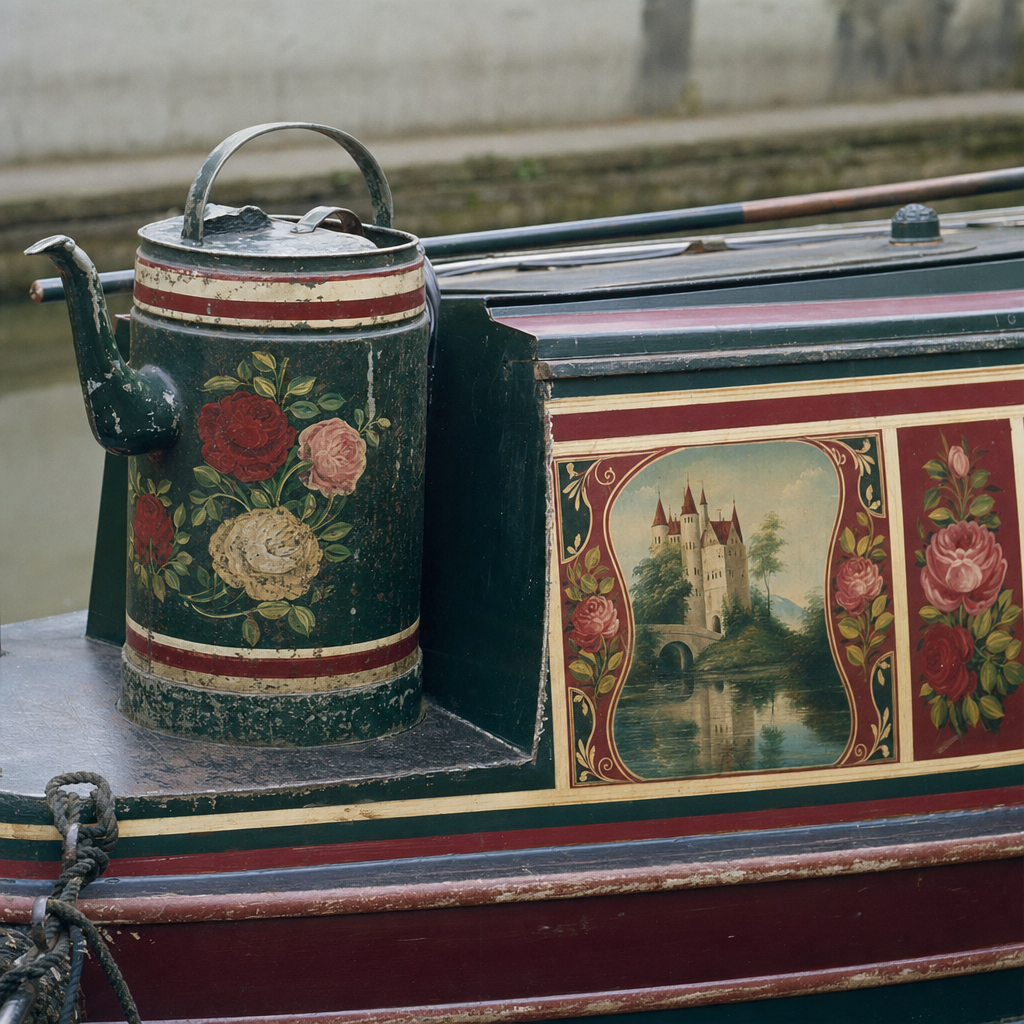
Roses and castles is the decorative painting found on Britain's working narrowboats: tight bunches of bright roses and small, romantic, fairy-tale castles, applied in hard-wearing enamel on cabin panels, doors, the tiller, and the water can. No one inventor is recorded — and that's the point. It spread boat to boat and painter to painter, which is exactly what makes it genuine folk art rather than a decorating fashion.
Why the boats got painted
The style took hold from around the mid-19th century, as the railways pulled the freight trade off the canals and whole families moved aboard to keep the boats working. A cabin was tiny and dark; the painting brightened it and, over time, became a badge of pride. Each boat carried its own livery and its own hand — the canal-boat painting style did the identity work that a name and a coat of arms do elsewhere.
The Buckby can and the painted objects
The most famous canvas wasn't the boat at all — it was the Buckby can, the water can that stood on the cabin roof, named after Long Buckby on the Grand Union, where the cans were decorated at the lockside. Painted head to foot in roses and castles, it's the single most iconic painted object of the tradition. Dippers, stools, hand bowls and the cabin's "scumbled" wood-grained panels all got the same treatment. The canal boat artists who painted them were often the boatyards' own signwriters, working fast and from memory.
The palette
Canal boat painting runs on a strict, durable palette: dark grounds — deep bottle green, oxblood red and black — with the roses themselves picked out in bright reds, pinks, yellows and white over the top. The restraint was practical — a handful of tough enamel colours that survived a working life — and it's why the tradition still reads as one coherent thing across two centuries of boats.
A short note on dates
The tradition is younger than people assume. The Canal & River Trust dates it broadly to the 19th century; canal historians (notably Tony Lewery) pin the earliest documented painted water can to about 1858, with the castle motif specifically recorded from 1873. So roses and castles isn't ancient; it's a Victorian working-class art form that matured alongside the family-boat era. That matters, because a lot of the romantic backstory you'll read was written long after the fact, and the honest answer to "where did it start" is that nobody wrote it down at the time.
What the motifs might mean
Here's where you have to be careful. Several explanations get repeated as fact; none of them is proven. The most common idea is homesickness — that boating families came off the land, and the roses and the green hills behind the little castles stood in for the rural life they'd left. It's a tidy story. It's also unverifiable.
A second theory points to Romani influence: a shared love of strong colour and ornamented living quarters, and the visual rhyme between a painted cabin and a painted gypsy caravan. There was some overlap between travelling and boating communities, so the idea isn't daft — but there's no documentary line that proves the canal style came from Romani decoration rather than simply rhyming with it. Read the two as cousins, not parent and child.
A third reading is the plainest and probably the soundest: the motifs are decorative, not symbolic. Roses and castles were the popular ornamental subjects of the day — they turn up on trays, tea caddies and fairground work too — and boat painters used what was fashionable and easy to lay down quickly. Treat any single-meaning explanation as a theory worth knowing, not a fact to repeat. The heritage bodies do the same.
Scumbling and the painted cabin
The roses get the attention, but the technique that holds the whole look together is scumbling — a fake wood grain dragged over a coloured base while the glaze was still wet. A painter would lay a brown or ochre glaze over a lighter ground, then comb or drag it with a rag, a brush or even a thumb to mimic figured oak or mahogany. It made cheap softwood panels look like joinery a working family could never have afforded, and it gave the bright roses a warm, grained field to sit against.
Almost nothing in the cabin escaped decoration. The water dipper, the folding stool, the enamel hand bowl, the cabin doors, the table cupboard — all of it carried roses, castles, scumbled grain or a band of geometric edging. The effect inside a six-foot cabin was dense and bright, a deliberate counter to the soot and the weather outside. A good painter could do the lot from memory in an afternoon, which is the mark of a true folk hand rather than a copied pattern.
Where to see it today
You don't have to take it on trust. The Canal & River Trust's roses-and-castles feature is the soundest short history online, and the National Waterways Museum — split across Ellesmere Port and Gloucester — holds painted boats, cabins and Buckby cans you can stand in front of. Go and look at the real thing before you trust any photo: the colours are deeper, the grain work is sharper, and the scale of a decorated cabin only lands in person.
The craft is still working, too. A handful of canal painters take commissions and turn up at the boat gatherings and festivals through the season, lettering names and decorating cans the old way. If you own a boat and want the genuine article, find one of them — it's a skill worth paying a craftsperson for, and the result outlasts any print.
Looking after painted ware
Old enamel painting is tougher than it looks, but it isn't immortal. Sun is the worst enemy — strong light fades the reds and pinks first, so keep a painted can or panel out of a hot window. Damp is the second: it lifts paint from wood and rots the substrate underneath, so anything stored over winter wants somewhere dry, not a cold shed. Clean gently, with a barely damp cloth and nothing abrasive; modern cleaners can dull or strip an old glaze in one wipe. If a genuinely historic piece is flaking, leave it and ask a conservator — a bad touch-up is worth less than honest wear.
A modern print is far less fragile, but the same one rule applies: keep it off a sun-blasted wall and the colour holds for years.
Where to see it — and how to keep it
Roses and castles is alive: specialist canal painters take commissions and work the festival circuit, and the canal museums hold fine historic examples. For the genuine hand-painted article on your own boat or a Buckby can, seek one of those painters out — it's a craft worth paying for.
What we make is the modern wall counterpart: not floral painting, but the boat's actual name set in editorial type, in the traditional green-and-oxblood spirit on cream archival paper. It reads as canal art at a glance and is specific to one boat. See the name print (from £19) or the canvas (from £45), and the wider guide to canal boat art.